Key takeaways
- Typing was never the slow part. Faster code completion just moves the pile-up to the next step.
- AI tends to agree with everything. Vadim's team builds systems that question the idea first, before any code is written.
- What decides whether AI can work on a large old system is how well it keeps track of context, and the model matters less.
- Building security and compliance from day one is now much cheaper, using separate security agents and human review where it counts.
- Realistic speed gains run from 2-3X on heavily regulated systems up to 20-30X on new features.
Most engineering leaders have already paid for the AI coding subscriptions. Fewer can point to the results.
That gap was the starting point for Vadim Peskov, CEO and Co-Founder of Diffco, on a recent episode of the Goodfirms Podcast. Diffco is an AI-first software engineering company founded in 2008 and based in San Jose, California, building for Silicon Valley startups and US enterprises in healthcare, finance, and other regulated industries. Vadim's argument is simple. Unless a team gives the AI a clear goal, the right tools, and a way to know when the work is done, it only speeds up one small step.
Drawing on his work with startups and regulated enterprises, Vadim shares a practical playbook for getting real results from AI in engineering.
Who Is Vadim Peskov?Vadim Peskov is the CEO and Co-Founder of Diffco, an AI-first engineering firm that has spent the last two years redesigning how software gets built and shipped. On this episode of the Goodfirms Podcast: Conversations That Matter, Vadim breaks down why AI-assisted development stalls, what agentic engineering changes in practice, and which numbers engineering leaders can realistically expect. |
Typing Was Never the Bottleneck
Developers now use AI code completion everywhere, yet most organizations report only small gains. Vadim traces this back to a first-principles mistake. The hard part of software is deciding what to build and how, and the coding itself comes after.
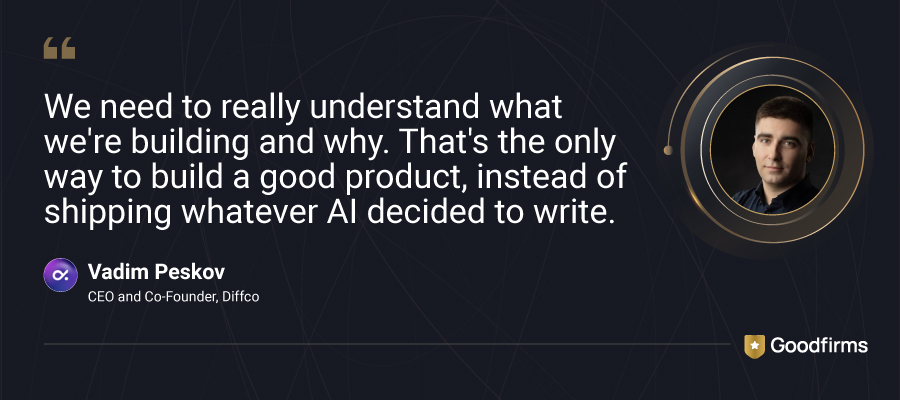
Anyone can now generate code for almost anything. Building a large system with heavy compliance requirements is a different job, and it depends on asking the right questions early. That is where Diffco built its own methodology around spec-driven development, backed by an internal harness that walks the team through the questions that matter for a specific client and industry.
The harness also fixes a built-in weakness. "AI by default is a wonderful yes man," Vadim said. "We actually want our system to be no, by default." A good human engineer pushes back on a weak idea before building it, and the system should do the same.
Where Code Generators Break Down
Inline generators fail earlier than most people expect, and the cause is context. A small feature in a clean codebase might work fine with a single prompt. A real product needs the whole picture: acceptance criteria, product direction for the next twelve months, and the technical debt a given path will create.
Brownfield products make it harder. Years of legacy decisions sit inside the system, and the AI knows none of them unless someone manages that context deliberately. Vadim's answer is multi-agent frameworks paired with knowledge graphs, which he calls the only approach that works right now for most codebases. Together, they let agents operate across context windows measured in hundreds of millions of tokens.
What Agentic Engineering Actually Changes
For a CTO, the distinction comes down to results. Plenty of companies pay for premium AI subscriptions without seeing production-level output.
Diffco has run AI-native transition work with two very different teams. One was a Series B startup with roughly 80 developers and a four-year-old system. The other was an enterprise with 250 developers and a system that was 15 to 20 years old. In both cases, the products had become a burden because the processes around them were built for humans rather than for how AI executes.
The startup is now rebuilding its whole platform with four people, including the CTO and one product person, and expects to reach 15 to 20 developers by the end. Cutting 250 people was not an option for the enterprise, so the goal was acceleration. Gains there went from around 50% to a range of 7 to 10X. The startup's gain is closer to 30X. Companies staying on legacy rails will only fall further behind.
Teams comparing outside help can start with a list of AI agent development companies that build this kind of workflow.
Keeping the Auditor Comfortable
Security and compliance are the biggest fears around autonomous agents. Vadim's design uses a separate set of agents dedicated to security, with human review at the points where it counts. Reading every line of code is usually useless today.
The bigger change is cost. Secure-by-design development used to double the price of a project or more. Building compliance from day one is now fast enough that skipping it rarely makes sense. HIPAA and SOC 2 work follows established playbooks. Higher-bar systems such as FedRAMP need a different conversation.
What Gains Are Realistic
Vadim is careful about numbers, because the answer depends on the type of project. Starting from zero, the gains are large. Starting from a legacy system with thousands of lines of code and poor documentation, results come slower.
His range of works from Diffco's own work looks like this:
- Complex systems moved in the right direction: around 5 to 10X
- Systems with heavy legal, privacy, or security requirements, such as FedRAM, are around 2 to 3X, because so much manual work remains.
- New feature builds: 20 to 30X
Writing code is no longer the slow part. Requirement collection is. Teams still have to talk to people, confirm what they want, and check with third parties about integrations and sandboxes. Wireframing now flows almost straight into working code, which makes approval easier. Diffco still designs proper design systems so the product does not look like AI slop, and a human still reviews everything. Someone has to understand what is being built.
The Senior Engineer's New Job
When agents do the heavy lifting, the scarce skill is understanding. Senior engineers need a clear picture of what matters to the client, plus a working knowledge of how LLMs, RAG, and graphs behave.
Vadim also changes where engineers look when something goes wrong. Fixing the code comes last. "Code is a last step," he explained, and the first check is whether the ticket, the request, or the partner input was wrong. An engineer who cannot explain why they chose an approach is a problem, because that is how teams end up shipping vibe-coded software nobody understands.
Looking two to three years out, he sees agencies shifting toward a product-plus-service model. Staying current also means retesting tools often. He dropped one tool from his pipeline in April, tried it again last week, and found it beat everything else on the same benchmarks.
Rapid Fire With Vadim Peskov
- One word to describe Silicon Valley right now? A bubble in a bubble.
- Will AI replace junior developers in three years? Already did.
- What is more dangerous, bad code or bad prompts? Bad prompts.
For the rest of the rapid-fire answers, check out the full episode on YouTube.
It's Not the Model. It's the Harness.
Asked for one piece of advice for engineering managers, Vadim kept it short: "It's not models, it's always harness."
Model quality will keep changing every few months. The harness is what turns any model into reliable output, and it is the part that a team controls. That means specs, memory, security agents, and a weekly habit of testing and improving it.
Conclusion
AI coding tools speed up typing, and typing was never where projects stalled. Vadim's point is that the gains come from redesigning how work flows, so agents get clear goals, the right context, and a definition of done.
You can check where your own team stands with a few questions. Ask who reviews the spec before anything gets built. Ask how agents get context on your legacy systems. Ask whether anyone can explain why a given approach was chosen. Teams still weighing outside partners can also compare software development companies on verified reviews before committing.
Where to Find Vadim Peskov and Diffco
Website: Diffco
LinkedIn: Vadim Peskov
Conversations That Matter is the Goodfirms podcast featuring the practitioners, founders, and operators behind some of the most interesting companies in the world. Subscribe wherever you listen.