Key takeaways
- Embedded software development means writing the code that runs inside a physical device, like a smartwatch, a car part, or a factory sensor.
- The embedded software market was about $17.90 billion in 2024 and is projected to reach $30.23 billion by 2030, according to Grand View Research.
- Most projects cost between $40,000 and $400,000. Medical and automotive devices sit at the higher end.
- Plan the hardware and the software together. It saves you from expensive redesigns late in the build.
- Security and compliance rules like IEC 62304, ISO 26262, and the EU Cyber Resilience Act need attention from day one.
- Look for a partner who knows C, C++, and Rust, has RTOS experience, and has worked in regulated industries.
Almost every smart device you use has a tiny computer inside it. Your smartwatch, an insulin pump, a car's braking system, and a factory sensor all run code built for one job. That code is embedded software.
For entrepreneurs, this matters because hardware products now win or lose on their software. A device that can update itself, report faults, and run a small AI model stands out from one that only does basic tasks. Building it is harder than building a web app. A bug in a shipped device can force a recall, and fixing it later is not always possible.
This guide explains what embedded software development is, how the process works, what it costs in 2026, and how to pick the right partner. It is written for founders and product leaders who want to make smart decisions without learning to code firmware.
Ready to hire an Embedded software development company? Compare verified providers by client reviews, hourly rates, and team size before you shortlist.
What is Embedded Software Development?
Embedded software development is writing code that runs directly on a specific piece of hardware. Think of the chip inside a thermostat or the control unit in a car engine. The code does one job and works with very little memory, power, and processing speed.
Three terms get mixed up a lot, so here is a quick way to tell them apart.
- Embedded system: the whole device, meaning the hardware and the software running on it.
- Embedded software: the code inside that device, from drivers to the app logic.
- Firmware: the low-level code that starts the hardware and controls parts like sensors and radios.
It also works differently from regular software.
- A small chip may have only a few hundred kilobytes of memory, so every bit counts.
- Timing is strict. An airbag controller has to react in milliseconds, every single time.
- Updates are harder. Devices sit in homes, cars, and factories, so you need a secure over-the-air update plan from day one.
- Mistakes cost more. A web app bug gets fixed by evening, while a bug in a shipped device can mean a recall.
Why Embedded Software Development Matters for Entrepreneurs in 2026
More products now ship with a chip and a network connection, so embedded software development keeps growing. Grand View Research valued the market at about $20.8 billion in 2026 to USD 42.6 billion by 2033, at a CAGR of 10.8% from 2026 to 2033. IoT, edge computing, on-device AI, and 5G are driving most of that growth.
Here is what that means for your business.
- Devices report their own status, so you catch problems before customers do.
- Usage data helps you plan repairs before a machine breaks down.
- You can update and fix devices in the field without sending a technician.
- Sensor data shows how people really use your product.
- Connected devices let you add service plans and subscriptions on top of the hardware sale.
Think of a connected coffee machine that warns the service team about a failing pump before it stops working. That is the kind of edge embedded software gives a product.
What Does Embedded Software Development Cost in 2026?
Most embedded projects cost between $40,000 and $400,000. The range is wide because hardware, testing, and compliance push the price up more than the coding itself.
|
Project tier |
Typical budget |
What you usually get |
|---|---|---|
|
Basic MVP |
$10,000 to $30,000 |
Limited firmware for a proof of concept |
|
Mid-tier |
$40,000 to $120,000 |
Connected or industrial devices with several integrations |
|
High-compliance |
$150,000 to $250,000+ |
Medical or automotive systems with certification work |
If you want to test a hardware idea first, the MVP development cost guide shows how budgets grow from prototype to production.
What Pushes the Cost Up
- Scope and hardware complexity. Real-time and multitasking work can push a budget past $200,000.
- Integrations with cloud platforms, business systems, or third-party devices. These can add $10,000 to $60,000.
- Compliance and security work, such as audits and certification testing. This can add $20,000 to $100,000.
- A companion app. It has its own budget, so check the mobile app development cost separately.
- Maintenance, which usually runs 15 to 20% of the build cost every year.
Payment Models
- Fixed price works when the scope is clear and unlikely to change.
- Time and materials suits projects where requirements will keep evolving.
- A dedicated team fits long projects that need steady, ongoing work.
Timelines and Pricing Data
Simple firmware takes 3 to 6 months. Smart connected devices take 6 to 12 months. Automotive and industrial platforms can take 1 to 3 years because of testing and compliance.
Goodfirms also ran a 2026 survey on custom software pricing. It found that 66% of companies charge $30,000 to $100,000 for small and mid-sized builds. Scope creep added another 10 to 25% to budgets.
Where you hire matters, too. Goodfirms has reviewed 116 embedded software development companies across 35 countries as of September 2026. The median hourly rate is $37. North America averages around $111 an hour, and Oceania $163, while South Asia averages $42. India is the top value pick, with 44 top software development companies averaging $41 an hour and a 5-star client rating.
How Embedded Software Is Structured
Think of an embedded product as a stack of layers. Each one depends on the layer below it.
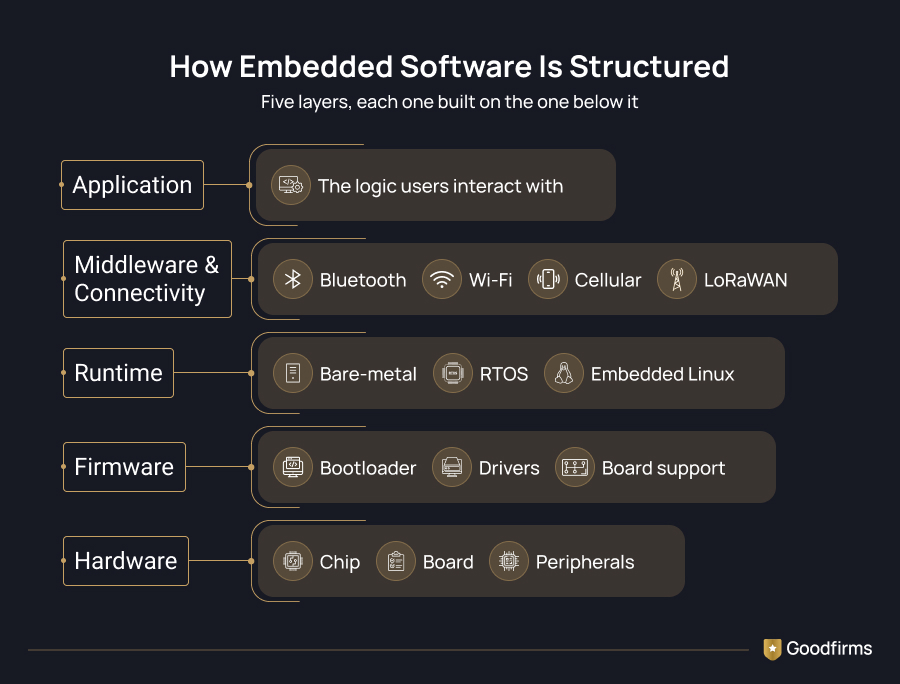
1. Hardware: the chip, the board, and the parts around it. They set hard limits on what the software can do.
2. Firmware: the bootloader, drivers, and board support code. This layer starts the device and handles updates.
3. Runtime: the code can run bare-metal, on a real-time operating system (RTOS) like FreeRTOS or Zephyr, or on embedded Linux for bigger devices.
4. Middleware and connectivity: the software that connects the device over Bluetooth, Wi-Fi, cellular, or low-power networks like LoRaWAN.
5. Application: the part users care about, like a thermostat schedule. More devices now run small AI models here, and AI development companies can help when you plan that.
Embedded systems also fall into four types.
- Real-time systems must respond on time, every time. Pacemakers and airbags are hard real-time. Streaming devices are soft real-time.
- Stand-alone systems, like calculators and cameras, work on their own.
- Networked systems, like smart meters, share data over Wi-Fi, Bluetooth, or cellular.
- Mobile systems, like wearables, need a small size and low power use.
Most products mix two or three of these. A connected insulin pump, for example, is real-time, networked, and battery-powered.
What Is the Embedded Software Development Process?
The embedded software development process, also called the embedded software development lifecycle, takes a device from idea to a supported product in the field. Most teams follow eight steps.
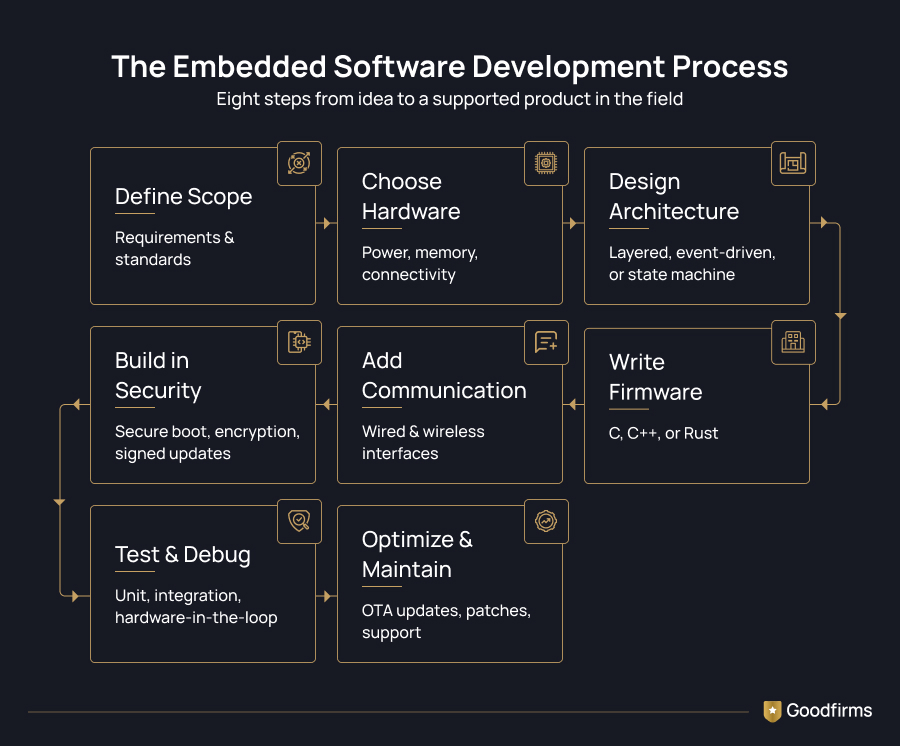
1. Define scope. Write down what the device does, who uses it, and where it runs. List limits like power, memory, and response time, and note any standards that apply.
2. Choose the hardware. Compare processing power, memory, connectivity, and power draw. Decide what runs on the device and what runs in the cloud before you pick the chip.
3. Design the architecture. Pick a layered, event-driven, or state machine design. Lock the hardware and software interface early and track every change to it.
4. Write the firmware. Most teams use C or C++, with Rust for security-sensitive parts.
5. Add communication. Choose wired options like SPI, UART, and I2C, or wireless ones like Wi-Fi, Bluetooth, LoRa, cellular, and 5G. Range, speed, and power use guide the choice.
6. Built-in security. Add secure boot, encryption, and signed updates while designing. Adding them late costs far more.
7. Test and debug. Run unit, integration, and system tests. Include hardware-in-the-loop tests, since timing bugs only show on real hardware, and use static analysis with a standard like MISRA C.
8. Optimize and maintain. Check the memory and power on the real chip. Ship with over-the-air updates and a safe fallback, and plan for patches after launch.
Regulated devices usually follow the V-model, where every design step has a matching test. Auditors for IEC 62304 and ISO 26262 look for that link. Agile works well for apps and cloud parts. Most projects use a mix of both.
Programming Languages and Tools
C is the default language because it runs on almost every chip and uses very little memory. C++ adds structure for larger applications. Rust catches memory bugs before the code runs. Python helps with prototypes and higher-level logic.
CISA and the NSA point out that around 70% of serious security vulnerabilities come from memory safety issues. That is why many teams start small and rewrite one module in Rust, such as the communication stack.
If you are wondering how to learn embedded software development, the FAQ at the end has a simple path. If your firmware uses C++, you can compare C++ development companies by rating and rate.
Embedded Software Development Tools
- Cross-compilers build code on a PC for the target chip.
- IDEs like Eclipse, Visual Studio Code, and STM32CubeIDE bring editing, building, and debugging into one place.
- Debuggers over JTAG or SWD let engineers look inside the device while it runs.
- Emulators like QEMU and Renode let teams test firmware before the hardware arrives.
- Vendor SDKs, such as STM32Cube, supply drivers and libraries for a chip family.
Embedded Software Development Across Industries
A car, an insulin pump, and a warehouse tracker all run embedded software, but the rules for each are very different. Here is how five common industries use it, starting with automotive.
Automotive Embedded Software Development
Automotive embedded software development covers engine control, braking, driver assistance, and infotainment. ISO 26262 grades risk from ASIL A to D, and higher levels need more testing and proof. You can start with automotive IoT development companies that already work under these rules.
Other Industries
- Healthcare: medical devices follow IEC 62304, which sorts software into Class A, B, and C by how much harm a failure could cause. Class C needs the most testing and documentation.
- Industrial: factory devices deal with heat, dust, and shaky networks. Secure boot and signed firmware protect the plant network. Take a look at manufacturing IoT development companies for options.
- Logistics: trackers and cold chain sensors run on small batteries with patchy coverage, so low-power design and reliable updates matter most.
- Consumer devices: wearables and smart home products need sensing, connectivity, and app pairing. Founders here often need IoT development companies that handle firmware, cloud, and a companion app together.
Security and Compliance
Attackers can reach a device through its hardware, its radios, and its update channel. Microsoft's Security Signals research found that 80% of organizations had a firmware attack within two years. Four basics help. Use secure boot so only trusted firmware runs, and keep keys in secure hardware. Encrypt data on the device and in transit. Sign every update so it can roll back if something fails.
These are the main standards to know.
- IEC 62304 for medical device software.
- ISO 26262 for automotive safety.
- IEC 62443 for industrial control security.
- EU Cyber Resilience Act for connected products sold in Europe. It entered into force in December 2024. Reporting duties for actively exploited vulnerabilities and severe incidents started on 11 September 2026, and the main obligations apply from December 2027. Fines can reach 15 million euros or 2.5% of global turnover, whichever is higher.
Embedded Software Development Outsourcing: In-House or Partner?
Build in-house if embedded work is a long-term core skill for your company. Hire an outside partner if you need speed or rare skills, since hiring a full embedded team takes time. Many first-time hardware founders pick a hybrid setup, where the partner builds, and your team owns the product direction. Embedded software development services from an outside team usually cover architecture, firmware, testing, and release support.
How to Choose an Embedded Software Development Company
A regular software vendor and an embedded specialist can look the same on paper. When you check an embedded software development company, look for these things.
- Strong C, C++, and Rust skills, and the sense to pick the right one for each project.
- Hands-on experience with bare-metal and RTOS builds.
- Security is built into the process, including secure boot, key management, and signed updates.
- Proof from regulated industries, such as past work under IEC 62304, ISO 26262, or IEC 62443.
- Experience with your chip family and connectivity protocols.
- One team that covers firmware, hardware, cloud, and device management.
- A clear plan for support after launch.
Ask a few direct questions before you sign.
- How do your hardware and firmware teams work together when board plans change?
- What does the device do when the network drops or an update fails?
- What test evidence do you share beyond saying testing passed?
- Who makes the call when a serious issue shows up?
- What support do you offer once real-world data shows new problems?
A good partner for embedded software development services covers the whole lifecycle. Some teams start with embedded software development consulting services, a short paid discovery for architecture, hardware choice, and a first cost estimate. In-house teams also use embedded software development consulting services for an outside architecture review.
Be careful with an embedded software development company that talks only about hourly rates. The same goes for one that keeps engineers out of sight until kickoff or hides risk in status reports.
Embedded Software Development Best Practices
These habits keep bugs out of the device before they reach customers. Most are cheap to start on day one and expensive to add later.
- Test on real hardware and automate it.
- Run static analysis on every code merge.
- Pin your toolchain versions, so the build you certified is the build you ship.
- Design a safe fallback so a power cut during an update does not brick the device.
- Build in logging, so a device with no screen can still tell you why it failed.
- Measure power and timing on the actual chip, since desktop instincts often mislead on a microcontroller.
Embedded Software Development Trends to Watch in 2026
Four shifts are changing how embedded products get built and shipped this year.
- Edge AI: small models now run on the device itself, which cuts delay and keeps sensitive data local.
- Rust: more teams adopt it one module at a time for safer code.
- Regulation: the EU Cyber Resilience Act is raising the security bar for almost every connected product.
- Over-the-air updates: buyers now expect fixes and new features after they buy.
Final Thoughts on Embedded Software Development
Good embedded software development is what makes a device smart. It decides how fast the device responds, how safe it is, and how well it holds up years after launch. Getting it right early saves a lot of money and stress later.
Here are a few things to keep in mind as you plan.
- Plan the hardware and the software together.
- Set a realistic budget that covers compliance and yearly maintenance.
- Bring security in from day one.
- Pick a partner who has shipped devices in your industry and can show real test results.
If you are just starting out, write one page that covers what the device should do, where it will run, and which standards apply. That page makes every vendor conversation easier and every quote easier to compare. Share it with a few providers and see who asks the smartest questions.
FAQs - Embedded Software Development
1. What is embedded software development?
It is the work of designing, writing, and testing code that runs on dedicated hardware like microcontrollers. The code handles one job inside devices such as smartwatches, car control units, and medical monitors. It works within tight limits on memory, power, and timing.
2. What does embedded software development cost?
Most projects cost between $40,000 and $400,000. A basic MVP starts around $10,000 to $30,000, and mid-tier connected devices run $40,000 to $120,000. Medical or automotive systems can reach $150,000 to $250,000 or more. Maintenance adds about 15 to 20% of the build cost each year.
3. What is the embedded software development process?
It has eight steps. Teams define scope, choose hardware, design the architecture, write firmware, add communication, build in security, test and debug, then optimize and maintain. Regulated projects follow a V-model, so every requirement links to a test.
4. How long does embedded software development take?
Simple firmware takes 3 to 6 months. Smart connected devices take 6 to 12 months. Complex automotive or industrial platforms can take 1 to 3 years because of hardware integration, real-time testing, and certification.
5. How to learn embedded software development?
Start with C and basic electronics, then practice on a development board like an STM32 or ESP32. Next, learn an RTOS such as FreeRTOS or Zephyr, along with SPI, I2C, and UART. Build small projects that read sensors and send data.
6. Which programming language is best for embedded software development?
C is the default because it runs on almost every microcontroller. C++ suits larger applications, and Rust is growing fast for safety and security critical firmware. The best pick depends on your chip, timing needs, and compliance path.
7. Should I outsource embedded software development or build in-house?
Outsource when you need speed or rare skills. Build in-house when embedded work is a core, long-term capability. A hybrid model works well for many founders, with a partner building and your team owning the product direction.