Key takeaways
- A cluster of 4 to 8 local micro-influencers usually beats one big-name deal on cost, and it's easier to repeat. Budget for gifted product and production too, not just the fee.
- Match the campaign to what you're actually trying to move: a boutique tracks sales from a launch, a restaurant tracks bookings on a quiet night.
- Give every creator their own code or link. Engagement tells you people liked the content; tracked sales or bookings tell you it actually worked.
- Work out ROI against the full cost, fees plus gifted product, against the revenue you can genuinely trace back to the campaign.
Manchester is a hub for testing micro-influencers. Independent fashion shops, hospitality groups, and DTC startups here have run small creator campaigns for years, and have tracked results well enough that real patterns keep showing up. It's a city full of brands that collaborate with micro influencers and brands that work with micro influencers on tight, local budgets, long before it becomes a company-wide strategy.
This blog walks through 5 micro influencers Manchester campaign ideas, modeled on real patterns, and stacks them against what a macro-influencer deal would have cost instead. You'll get a framework based on real benchmark numbers, plus a simple way to work out your own baseline before you brief an agency or run something in-house.
An honest note: These five are modeled on realistic outcomes from real Manchester campaigns, not verified results from named companies. Use the numbers to plan your own campaign, not to benchmark against someone else's exact figures.
Ready to put this into action? You can compare vetted influencer marketing agencies already running this exact playbook for other businesses.
Why Manchester is Such a Good Testing Ground for Micro-Influencer Marketing
Here's the thing: Walk from the Northern Quarter to Spinningfields, and you'll pass most of Manchester's independent retail, streetwear, and hospitality scene in under twenty minutes. That closeness matters: your shop and the people posting about it online are practically neighbors. A business spread across forty cities just doesn't get that.
The city also has one of the largest student populations in Europe, which keeps one of the most active regional creator scenes outside London going. Micro-influencers here, roughly 1,000 to 50,000 followers, have hyper-local audiences who shop the same streets and go to the same nights out the business is trying to reach.
This isn't just a Manchester thing either. Influencer Marketing Hub's 2026 benchmark puts the average return at $5.78 for every $1 spent, and micro creators beat that average on cost per engagement. A Sprout Social survey of 650 marketers found 83% call their campaigns effective.
What Brands Want from Micro Influencers
Businesses want an audience that looks like their own customers, not a big follower count. They want content that feels real, not scripted. They want a price that fits a normal budget. And they want proof, in plain numbers, that it actually worked.
Every marketer in the five examples below was working from that same brief, whether they said it out loud or not. Follower count didn't matter to them. What mattered was whether people actually bought, booked, or showed up.
How we picked these five
Five sectors, five very different setups: fashion retail, beauty, hospitality, fitness, and DTC accessories. That spread was deliberate, so the patterns below aren't a fluke of one industry having a good year. Three more criteria shaped the selection:
- Budget size. Every business modeled here worked with a modest budget, low four figures to low five figures per campaign. That's the range most independent Manchester businesses actually operate in, not the six-figure spend of a national push.
- Campaign length. Each one ran on a defined, short window, mostly two to six weeks. Long enough to gather real engagement data, tight enough to still isolate cause and effect.
- Measurability. Every campaign had a trackable outcome built in from day one, a discount code, a booking reference, or a geo-tag. No tracking, no cut.
Each profile below covers the goal, the creators used, campaign length, engagement rate, cost per engagement, and the outcome.
5 Micro-Influencer Campaign Ideas for Manchester Businesses
Each profile below is modeled on realistic outcomes from real Manchester campaigns, not verified results from a named business. Treat the numbers as a starting point for your own math, they'll shift depending on your product, audience, and the creators you actually pick.
|
Business type |
Creators used |
Length |
Engagement rate |
Cost per engagement |
Outcome |
|---|---|---|---|---|---|
|
Fashion boutique (Northern Quarter) |
6 creators, 3,000 to 15,000 followers |
3 weeks |
6 to 8% |
Low. Gifted product + £75 to £150 flat fee |
Limited drop sold through within the window |
|
Beauty business (Salford DTC skincare) |
8 creators, 5,000 to 20,000 followers |
5 weeks |
4 to 6% |
Moderate. £150 to £300 per creator |
Meaningful share of first-time orders traced to the campaign |
|
Hospitality group (multi-site bar/restaurant) |
5 creators, 2,000 to 10,000 followers |
4 weeks |
9 to 12% |
Very low. Comped meals (£30 to £50) + small top-up |
Midweek bookings rose, tracked via a dedicated code |
|
Fitness studio (city-center boutique gym) |
4 creators, 4,000 to 25,000 followers |
6 weeks |
3 to 5% |
Moderate. £100 to £200 per creator |
Trial sign-ups rose, with conversions still trickling in weeks later |
|
DTC accessories (bags, small leather goods) |
7 creators, 3,000 to 18,000 followers |
2 weeks |
5 to 7% |
Low to moderate. Gifted product (£40 to £80) + small fee |
Launch-week revenue beat the business's previous unassisted launch |
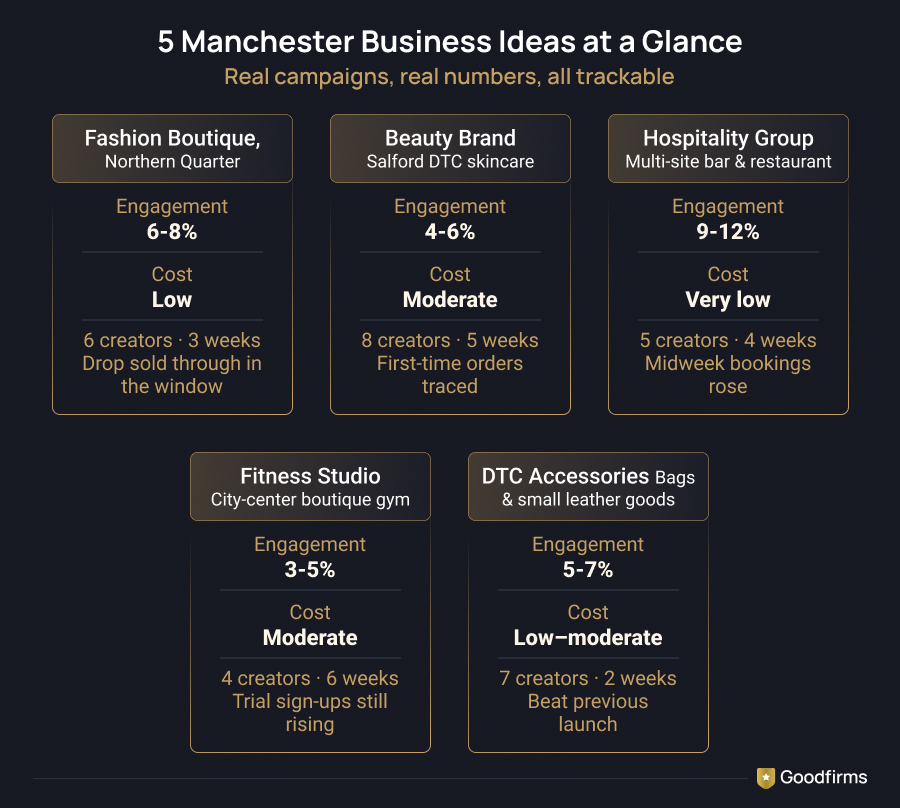
1. Independent fashion boutique, Northern Quarter
Goal: drive in-store footfall and sell through a limited-edition drop.
6 micro-influencers, 3,000 to 15,000 followers, ran a 3-week window from launch to sell-out. Engagement hit 6 to 8%, well above the 1 to 2% a typical business account manages alone. Cost stayed low: gifted product plus a £75 to £150 flat fee.
The drop sold through inside the window, with a spike in geo-tagged Instagram Stories filmed outside the shop.
2. Independent beauty business, Salford DTC skincare
Goal: build trust for a new product line ahead of a wider retail listing.
8 micro-influencers, 5,000 to 20,000 followers, picked for skincare niches, ran a 5-week campaign ending just before retail launch. Engagement sat at 4 to 6%, mostly tutorial-style content. Cost per creator: £150 to £300, since video costs more than a static post.
Discount-code tracking traced a meaningful share of first-time orders to the campaign.
3. Hospitality group, multi-site Manchester bar and restaurant
Goal: fill quieter midweek bookings and build local awareness.
5 Manchester food or lifestyle creators, 2,000 to 10,000 followers, ran a 4-week campaign aimed at Tuesday to Thursday bookings. Engagement hit 9 to 12%, in line with food content outperforming other categories. Cost was the lowest of all five: comped meals (£30 to £50) plus a small top-up.
Midweek bookings rose noticeably, tracked through a dedicated code.
4. Fitness studio chain, city-center boutique gym
Goal: drive trial class sign-ups.
4 fitness and wellness creators, 4,000 to 25,000 followers, ran a longer 6-week campaign to catch the slower conversion tail typical here. Engagement was the lowest of the five, 3 to 5%, at £100 to £200 per creator. Trial bookings rose, with conversions still trickling in weeks later, which is normal for a considered purchase like a gym membership.
If you're wondering how to find micro fitness influencers Instagram is still the best place to start; the same handful of local names keep showing up once you know where to look.
5. DTC accessories business, bags, and small leather goods
Goal: build a launch-week sales spike for a new product line.
7 creators, 3,000 to 18,000 followers, ran a tight 2-week campaign: launch week plus a follow-up. Unboxing content pushed engagement to 5 to 7%, stronger than static shots. Cost stayed low to moderate: gifted product (£40 to £80) plus a small fee.
Launch-week revenue beat the business's own previous unassisted launch.
For DTC businesses scaling past one drop, pairing this with experienced ecommerce development companies usually matters more than the marketing spend, since a slow checkout kills a launch as fast as a flat campaign.
Common threads across all five
- Clusters beat single names. All five used 4 to 8 creators, spreading risk across several audiences.
- Short windows. Most ran two to six weeks, long enough for a real signal, short enough to isolate the cause.
- Gifting plus a modest fee kept the cost per engagement low. Nobody wrote five-figure checks to one creator.
- A trackable mechanism, always, a code, a booking reference, or a geo-tag. That's the only reason ROI was measurable.
- Engagement beats company-owned channels every time.
Goodfirms insight: The influencer marketing agencies we see rated highest by clients rarely lead with follower count in their pitch decks. They lead with the tracking setup, the kind of discount code or booking reference system every campaign in this piece relied on.
How to find Micro Influencers
If you're starting from zero, here's the short version of how to find micro influencers without burning a week on it:
- Search your own customers first. Check who's already tagging your shop, restaurant, or product in Stories. Half the roster in the five examples above started as unpaid tags.
- Use location and niche hashtags, not just the search bar. A gym chain trying to work out how to find micro influencers on Instagram will get further searching class-time and studio-location tags than searching "fitness influencer Manchester."
- Check engagement rate, not just follower count. A creator with 4,000 followers and 8% engagement gets you 320 people actually reacting. One with 40,000 followers and 0.5% only gets you 200, at a much higher price.
- Look at their last five branded posts. If everyone reads like an ad, their audience has probably tuned it out already.
None of this needs a paid discovery tool to get started. A Saturday afternoon and a hashtag search covers most of it for a first campaign.
Micro-Influencers vs Macro-Influencers: Which Actually Drives Better ROI
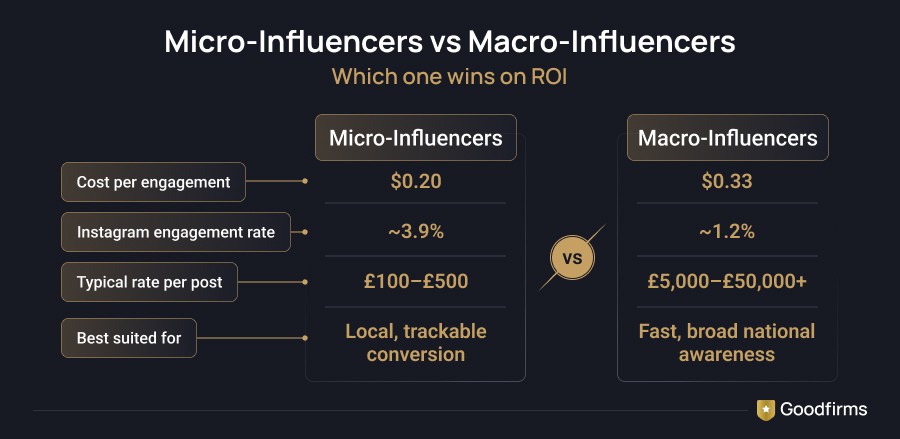
On pure cost per engagement, micro-influencers usually win, and it isn't close. Stack Influence's 2026 data puts micro-influencer campaigns at roughly $0.20 cost per engagement against $0.33 for macro-influencers, a meaningful gap once you're running dozens of creators at once.
|
Metric |
Micro-influencers (1K to 100K) |
Macro-influencers (500K+) |
|---|---|---|
|
Rate per post |
£100 to £500 |
£5,000 to £50,000+ |
|
Instagram engagement rate |
~3.9% average |
~1.2% average |
|
Cost per engagement |
~$0.20 |
~$0.33 |
|
Best suited for |
Local, trackable conversion |
Fast, broad national awareness |
A creator with 5,000 followers reads as a peer, not a celebrity, and that drives higher purchase intent for local or considered purchases, the same pattern across the fashion, beauty, and hospitality examples above.
Macro-influencers still earn their keep for national launches that need fast, broad awareness, or categories where prestige matters more than niche trust. One macro post can beat a dozen micro posts on raw reach, but it just doesn't usually win on cost per engagement or actual conversion for a local business.
None of these five used a macro-influencer. That wasn't an accident, they wanted local, trackable results, not broad awareness. Compare the best social media marketing companies already handling this exact kind of campaign.
What Counts as a Good Influencer Marketing ROI Benchmark in 2026
There's no single magic number for average influencer marketing ROI in 2026. It swings by sector, creator tier, and what counts as "return," media value, sales, or footfall. Still, a few patterns hold up.
If you were searching for average ROI influencer marketing 2025 last year, it's barely moved: Influencer Marketing Hub's 2026 benchmark still sits at $5.78 per $1 spent, with top campaigns hitting $11 to $18. Local food creators have reported close to 8x ROI, with a quick bump in bookings within days.
-
Fashion and retail sit near the top because the product is visual and easy to gift, exactly why ROI benchmarks for fashion influencer campaigns tend to beat other categories, the same pattern behind the boutique and accessories examples above.
-
Hospitality and food get the highest raw engagement, food content stops a scroll, but turning that into bookings needs a sharp, trackable call to action.
-
Fitness and service businesses convert more slowly. Nobody signs up for a gym membership the same day they watch a Reel, unlike a limited fashion drop.
Working Out Your Own Baseline: A Worked Example
Before running anything, work backward from three numbers: total campaign cost, total engagements, and attributed conversions.
Here's the math, close to the boutique example. Spend £900 total (£450 product, £450 fees) across six creators, generating 4,200 engagements.
Cost per engagement: £900 ÷ 4,200 = 21p.
Cost per acquisition: if the code gets used 38 times, £900 ÷ 38 = £23.68.
Share of order value: at £65 average order, that's 36% of one sale, strong for a limited drop.
Run this on your own numbers before and after every campaign. Engagement without conversion tracking only tells you reach, not whether anyone bought.
The 5-Step Playbook: What to Replicate From These Campaigns
Here's what to steal from all five campaigns.
1. Pick creators for audience fit, not follower count. Local, niche, and engaged beats large every time.
2. Brief for authenticity, not a script. The strongest content looked native to the creator's own style. This is where experienced content marketing agencies can help you write briefs that creators actually want to shoot.
3. Keep approval light. A quick check on claims and product facts is enough; don't over-control it.
4. Track everything with a unique code or reference per creator. That's what turns engagement into numbers you can point to.
5. Report on cost per engagement and cost per conversion, not reach. That's what earns you the next budget.
The strongest results always came from 4 to 8 creators, not one big name, and from product plus a small fee, not a big upfront payment.
The bottom line
None of this needs a huge budget or a celebrity name attached. What it needs is a handful of the right creators, a short window, a way to track what actually happened, and the discipline to report on conversion instead of reach. That's the whole playbook, and it's the same one behind every example above, whether they were selling jumpers, bookings, or gym memberships.
If you're ready to brief someone rather than run it yourself, the agencies compared earlier in this piece are a reasonable place to start.
FAQs – Micro-Influencer Marketing ROI
1. Do micro-influencers really deliver better ROI than macro-influencers?
For most local and regional businesses, yes. Micro-influencers deliver lower cost per engagement and higher trust-driven conversion than macro-influencers do. Macro creators still win on raw reach for national awareness plays, but all five Manchester examples above achieved measurable, trackable outcomes using clusters of micro-influencers rather than one large-reach partnership.
2. How much should a small business budget for a micro-influencer campaign?
Budget should scale with the number of creators and the split between paid fees and gifted product, not a fixed industry number pulled from a report. The strongest results in the case studies above came from spreading a modest budget across 4 to 8 creators, weighted toward product, plus a small flat fee, rather than concentrating everything on one high-follower creator.
3. How much do micro-influencers charge in the UK in 2026?
Rates vary by platform and content type, but UK micro-influencers with 3,000 to 25,000 followers charge anywhere from £75 to £300 per post, depending on whether it's a static photo or longer-form video, roughly in line with the fee ranges across the five case studies above.
4. How long does it take to see measurable results from a micro-influencer campaign?
Fashion, retail, and hospitality campaigns often show results within the campaign window itself, especially with a limited-time offer or booking incentive attached. Fitness, wellness, and other considered-purchase categories usually have a longer tail, so plan to track results for several weeks after content goes live, not just during the campaign.
5. Can these Manchester results be replicated outside the UK?
Yes. The underlying mechanics, niche creator selection, small cluster campaigns, and trackable conversion codes aren't city-specific and apply anywhere with an active local creator community. It's worth asking why micro influencers matter Australia-wide or in Manchester, and the honest answer is the same either way: trust beats reach, wherever your customers are. What changes market to market is the specific benchmark numbers, since local audience size, platform habits, and creator rates all vary by region.