Key takeaways
- Software shows where a brand stands in AI answers; it doesn't rewrite content, build schema, or land PR — that part still needs an expert GEO agency..
- The cost of AEO software is $29 to $699+ a month, GEO agency retainers run $1,500 to $50,000+ — know which bracket actually fits before signing anything.
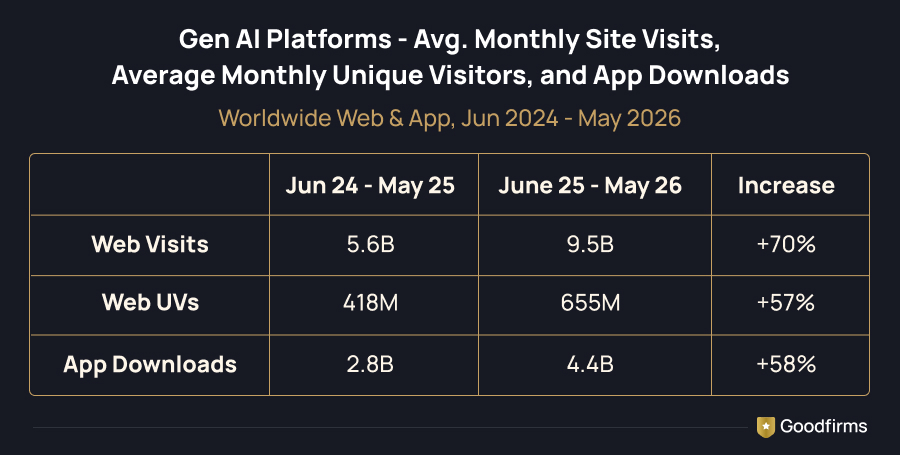
- Generative AI platforms pulled in 9.5 billion monthly visits between June 2025 and May 2026, up 70% year over year — this channel is already too big to skip.
- Pick based on the actual gap, not the price tag — a platform covers ongoing measurement, an agency covers structural fixes like thin content or missing schema.
- Most mid-size teams end up running a platform year-round and calling in an agency only for defined projects, not one or the other forever.
Search “best answer engine optimization platforms” and forty tabs open before your coffee gets cold. Every AI visibility tool vendor pitches the same three things: AI citation tracking, a share-of-voice chart, and a dashboard built for a sales demo. Strip off the logos, and most of these tools run on the same engine underneath.
That’s the real issue — not that the category is crowded, but that nobody tells you what a good score means, or admits the software won’t move a single number unless your team acts on it.
This article not only showcases the best AEO platforms but also breaks down what to look for, what's out there, what it actually costs — software subscriptions versus agency retainers — and when you actually need a GEO agency.
Compare the best GEO agencies on Goodfirms — side by side, backed by verified reviews.
Let’s start with knowing the best AEO tools that currently dominate this category — Profound, Otterly.ai, Peec AI, and Ahrefs Brand Radar, Semrush AI Visibility Toolkit, Scrunch AI, AthenaHQ, Rankscale AI— and each one is built for a different kind of buyer.
Best AEO Platforms in 2026
An AEO platform tracks how your brand shows up inside AI-generated answers — ChatGPT, Perplexity, Google's AI Overviews, whatever system someone happens to be using. There's no results page here, so it's not measuring your position on one. Instead, it's watching something more specific: whether a model, in the middle of generating a response, chooses to mention your brand from among the millions of sources it pulls information from.
Price, depth, and ease of use pull in opposite directions across these four — the table below lines them up side by side.
Best Answer Engine Optimization Platforms Compared
|
Platform |
Data Depth |
Ease of Use |
Fits Best |
Cost |
|---|---|---|---|---|
|
Profound |
Very high — multi-engine prompt testing, granular citation attribution |
Moderate — dense, analyst-oriented dashboards |
Enterprises, multi-brand portfolios, dedicated analytics teams |
$99/Month (Basic) |
|
Otterly.ai |
Moderate — covers major LLMs with simpler prompt sets |
High—speed setup, clean UI |
Lean marketing teams, small agencies |
$29/Month (Lite) |
|
Peec AI |
Moderate-to-high engine coverage |
High — straightforward, low learning curve |
Teams wanting quick directional visibility without heavy onboarding |
$95/Month (Lite) |
|
Ahrefs Brand Radar |
Moderate — add-on layered on an existing SEO suite |
Very high if you already use Ahrefs |
Teams that want a lightweight AEO signal inside a tool they already pay for |
$199/Month (Basic) Free Version: No |
|
Semrush AI Visibility Toolkit |
Moderate — four engines, add-on layered on Semrush's SEO suite |
High if already on Semrush |
Teams that want AI visibility inside a suite they already run |
$117.33/Month (Base, per domain) Free Version: Yes |
|
Scrunch AI |
High — crawler and agent-traffic diagnostics layered on citation tracking |
Moderate — more setup for crawler/log data |
Enterprise and engineering-led teams wanting diagnostics, not just a score |
$250/Month (Core) Free Version: No |
|
AthenaHQ |
High — 8+ engines plus an automated recommendation engine |
Moderate — credit-based usage adds a learning curve |
Teams that want visibility data paired with ready-to-ship fixes |
$295/Month (Self-Serve) Free Version: Yes |
|
Rankscale AI |
Moderate-to-high — 17+ engines tracked via credits |
High — familiar rank-tracker style UI |
Agencies wanting broad engine coverage at low cost |
$99/Month (Essentials) Free Version: No |
That comparison covers the specs. Here's what each platform is actually built for.
A Closer Look at Each AEO Platform
Below is the detailed information about each Answer Engine Optimization platform.
Profound — Best for Enterprise Teams & Fortune 500 Brands
Profound is the deepest tool in the category, purpose-built for teams that need granular, multi-engine citation data rather than a single visibility score. It tracks ChatGPT, Perplexity, Google AI Overviews, and Microsoft Copilot, and pairs that monitoring with "Profound Agents" that can act on the gaps it finds.
- Starting Price: $99/Month (Starter plan, ChatGPT only)
- Free Version: No
- Free Trial: 7-Day Free Trial, 50 prompts/day for 7 days
Why teams switch to Profound:
- The $399/month Growth plan adds Perplexity and Google AI Overviews plus CSV exports for client reporting
- Profound Agents can draft and publish content from the visibility gaps it surfaces, turning the dashboard into a workbench
- Enterprise adds unlimited view-only seats, SSO/SAML, SOC 2 compliance, and a dedicated account team
- Front-end browser tracking captures the actual response a user sees, not a thinner API-only version
Otterly.ai — Best for Solo Marketers & Budget-Conscious Small Agencies
Otterly.ai strips AI visibility tracking down to the essentials at the lowest credible entry price in the category, without gating core engines behind a sales call. Every plan, including the $29 tier, tracks daily across four major AI engines and comes with unlimited team seats.
- Starting Price: $29/Month (Lite plan)
- Free Version: No permanent free plan
- Free Trial: 7-day free trial, no credit card required
Why teams switch to Otterly.ai:
- Unlimited team members ship on every tier, even the $29 Lite plan
- Multi-country tracking across 50+ markets is included by default, not an add-on
- The $189/month Standard plan unlocks API and MCP access, plus 5,000 GEO URL audits, well below enterprise pricing
- A built-in GEO audit tool flags on-page fixes, not just a bare mention count
Peec AI — Best for Agencies That Want Clean, Client-Ready Dashboards
Peec AI trades some of the deeper engine coverage for speed and polish, making it the fastest AEO tool to onboard a client into. Every plan, including the entry tier, ships with unlimited seats and a built-in "Actions" engine that prioritizes citation opportunities instead of just counting them.
- Starting Price: $95/Month (Starter plan), $80/month billed annually
- Free Version: No
- Free Trial: 7-Day Free Trial, no credit card required
Why teams switch to Peec AI:
- Unlimited seats on every tier, including Starter, make it easy to loop in a full client team
- The source-attribution layer names the exact URLs AI engines cited, useful for outreach and PR follow-up
- Sentiment tracking is bundled into the $245/month Pro plan, where rivals often charge a premium for it
- A native MCP server lets the data plug directly into other AI workflows
Ahrefs Brand Radar — Best for Teams Already Living Inside Ahrefs
Ahrefs Brand Radar isn't a standalone product — it's an AI-visibility layer bolted onto an existing Ahrefs subscription, backed by a database of over 200 million real search-derived prompts. That makes it a strong fit for teams that already run their SEO workflow through Ahrefs and want AI citation data sitting next to it, not in a separate tab.
- Starting Price: $199/Month per AI platform (requires an active Ahrefs plan, from $129/Month)
- Free Version: No
- Free Trial: No dedicated free trial for Brand Radar itself
Why teams switch to Ahrefs Brand Radar:
- No separate seat fee — Brand Radar rides on whatever Ahrefs plan you're already paying for
- Bundling all six tracked engines runs $699/month, cheaper than stacking six specialist subscriptions
- The citation view cross-references AI mentions directly against Ahrefs' existing backlink and web index
- Topic-gap analysis shows exactly where a competitor gets cited on a query and you don't
Semrush AI Visibility Toolkit — Best for Teams Extending an Existing SEO Stack
Semrush folds AI-visibility tracking into its existing SEO Toolkit as a domain-based add-on rather than a standalone product, giving teams already running keyword and backlink data through Semrush a way to add AI citation tracking without a new login. The Base plan tracks brand mentions across ChatGPT, Google AI, Gemini, and Perplexity, alongside a site audit built specifically to flag what blocks AI crawlers from citing a page.
- Starting Price: $117.33/Month (Base, per domain)
- Free Version: Yes (10 Queries and 100 audited pages per month).
- Free Trial: 7-Day Free Trial
Why teams switch to Semrush AI Visibility Toolkit:
- Sits inside the same dashboard as Semrush's keyword, backlink, and content data, so AI visibility and classic SEO performance sit side by side
- The site audit flags on-page issues specifically blocking AI crawler citation, not just generic technical SEO problems
- Brand Performance reporting includes shareable report slides built for client or stakeholder reviews
- Add-on pricing scales per domain, useful for agencies already billing Semrush seats per client
Scrunch AI — Best for Teams That Need Crawler-Level Diagnostics, Not Just a Score
Scrunch pairs standard AI-citation tracking with crawler and agent-traffic analytics — recording which AI bots actually visited a site, which pages they read, and how that activity connects to referral traffic in GA4. That diagnostic layer is what separates it from tools that only report a visibility percentage.
- Starting Price: $250/Month (Core)
- Free Version: No
- Free Trial: 7-Day Free Trial, no credit card required
Why teams switch to Scrunch AI:
- Named AI-crawler and agent-traffic analytics show which bots visited a site and connect that activity to GA4 referral data
- The in-development Agent Experience Platform organizes brand knowledge into a structured, machine-readable layer AI crawlers can consume directly
- Native integrations with Cloudflare and Vercel simplify deployment for engineering-led teams
- SOC 2 compliance and white-glove onboarding on Enterprise suit teams with procurement requirements
AthenaHQ — Best for Teams That Want Automated Fixes Alongside the Data
Built by a team with backgrounds at Google Search and DeepMind, AthenaHQ pairs AI-visibility tracking with an Action Center that generates content and schema recommendations tied to specific citation gaps, and connects citation activity directly to Shopify revenue data.
- Starting Price: $295/Month (Self-Serve/Starter)
- Free Version: Yes — Essential tier (300 credits/month, 5 AI models)
- Free Trial: No dedicated free trial on paid tiers
Why teams switch to AthenaHQ:
- Automated recommendation engine ties visibility gaps directly to specific content and schema fixes, rather than leaving that step to the team
- Shopify and Webflow integrations connect AI citations directly to on-site revenue, not just mention counts
- Sentiment analysis flags when a brand is being cited but described inaccurately or unfavorably
- A free Essential tier gives a genuine, if capped, starting point before committing to a paid plan
Rankscale AI — Best for Agencies Wanting the Broadest Engine Coverage at the Lowest Entry Price
Rankscale extends a familiar SEO rank-tracker interface into AI search, monitoring more than 17 AI platforms and interfaces — a wider net than most competitors in this category cast at any price point. White-label reporting and REST API access on its Growth plan are built for agencies reselling AI-visibility monitoring to multiple clients.
- Starting Price: $99/Month (Essentials)
- Free Version: No
- Free Trial: Yes
Why teams switch to Rankscale AI:
- Tracks 17+ AI platforms and interfaces, among the widest engine coverage in the category
- White-label dashboards and a REST API on the Growth plan are built specifically for agencies reselling AI-visibility reporting
- Credits roll over month to month rather than expiring, useful for teams with uneven monitoring volume
- Unlimited search terms and all regions are included, even on lower tiers, rather than gated to Enterprise
Each of these best AEO tools wins on a different axis. The right pick depends on which one your team actually needs.
|
Note: These AEO tools have been selected based on AI-engine coverage, prompt and citation tracking, reporting capabilities, pricing transparency, usability, and suitability for different business sizes. The list includes both specialist AEO platforms and established SEO platforms with AI-visibility capabilities. |
Which AEO Tool Should You Choose?
There’s no single “best overall” pick, and hunting for one wastes your time. What matters is understanding which category these tools sort into — depth, ease of use, price — and knowing that nothing on the market maxes out on all three at once.
Enterprise-depth platforms cover the most engines, test the widest range of prompt variations, and give the most granular citation attribution.
Profound is the name people point to here, built specifically for large-scale prompt monitoring and citation analytics across major models.
Its co-founder and CEO, James Cadwallader, has argued the shift is only getting started. He told Fortune in February 2026:

In the future, every company on the planet will care deeply about how AI talks about and surfaces — and at some point interacts with — their brand.
That’s the best enterprise-depth platforms are built on — teams with dedicated analysts who can sit inside dense data all day, not skim a summary once a week.
Ease-of-use platforms trade some of that granularity for faster onboarding and cleaner dashboards. Otterly.ai and Peec AI both sit closer to this end: a quick, readable read on visibility over an exhaustive prompt library. Good fit for smaller marketing teams or agencies juggling several clients who need a clear answer fast, not a research project.
Bundled or entry-tier tools trade coverage for convenience or price. Ahrefs’ Brand Radar rides inside a suite teams are usually already paying for, which makes it a low-friction add-on rather than a standalone AEO system. Entry-tier options generally cover fewer engines at lower prompt volumes, but they’re a reasonable place to start if you are looking which way to go before committing real budget.
Billions of monthly AI searches explain why this category exists — and why picking the wrong tool costs more than a subscription fee.
Before choosing a tool, it's worth knowing which goals this tool can help you achieve.
How Does an AEO Platform Work?
That question is bigger than it sounds. Generative AI platforms pulled in an average of 9.5 billion monthly visits worldwide between June 2025 and May 2026 — up 70% year over year, with unique visitors climbing 57% to 655 million, according to Similarweb’s 2026 Generative AI Landscape report. That’s a lot of moments where your brand either gets mentioned or quietly doesn’t.
Marketers are already feeling that shift: according to Goodfirms' research - AI SEO Statistics 2026, 65% of respondents cite AI-driven search changes as the most prominent SEO challenge they're facing this year.
Traditional SEO software tracks rankings, backlinks, crawlability — things that live in a fixed, indexed order. AEO and GEO platforms track something far less stable: whether a model chooses you while it's generating an answer on the fly. No fixed page one. Just a probability of citation that shifts by prompt, by model, and sometimes by the day you happen to check. That doesn't make SEO optional — it's still what gets a page crawled, indexed, and trusted enough to be cited in the first place. The real question isn't SEO or AEO/GEO; it's whether a brand is investing in both the foundation and the layer built on top of it.
A real AEO platform needs to do three things well:
- Prompt tracking. Running sample questions through AI engines to see if and how your brand shows up in the answer.
- Citation detection. Identifying which sources the model actually pulled from — yours and your competitors’.
- Share-of-voice reporting. How often you appear relative to competitors across a defined set of prompts and topics.
Plenty of vendors bolt on brand monitoring or social listening as extras. Fine add-ons, not the core job. If a tool can’t show you prompt-level visibility with source-level citations attached, you’re looking at a rebranded monitoring dashboard wearing an AEO label.
A demo can make any dashboard look credible. The below four criteria separate the tools that stays relevant in the long run.
How Should You Evaluate AEO Tools?
The below criteria should be considered when evaluating AEO tools before purchasing.
Tracking Depth
How many AI engines does it monitor, and how many phrasings per question does it actually test? A single model against five static prompts isn't visibility data — it's a narrow, skewed slice with a nicer label. Ask: how many LLMs does it query, does it test multiple phrasings, and how often does it re-run prompts?
Citation Coverage
This is about which engines and sources actually get citation attribution, not just which ones the tool can ping. Confirm: full query-plus-citation coverage versus query-only, whether it distinguishes a direct citation from a vague mention, and whether it tracks the trade publications and forums models actually lean on.
Reporting Quality
Raw numbers without interpretation aren't insight — they're homework. Push on actionability (does it flag specific gaps?), client-readiness (can a non-technical stakeholder read the export?), and trend granularity (change over time, or one aggregate score?).
Pricing and Scalability
Costs climb fast with topics, brands, or clients. Confirm what pricing scales on, whether new engines are bundled or a paid add-on, and what happens to historical data on downgrade or cancel.
So, we have now gone through the details about the best AEO platforms popular in 2026. But, wait, not every gap a platform flags can be fixed by software — for that you need an expert GEO agency. Let’s have a look at the top 10 GEO agencies to consider in 2026.
Best GEO Agencies in 2026
GEO companies help brands get cited inside AI-generated answers — ChatGPT, Gemini, Perplexity, Google AI Overviews — rather than just ranking on a search results page. Unlike AEO software, which only measures where you stand, a GEO agency also does the fixing — rebuilding thin content, closing structural gaps, and securing the external mentions a dashboard can flag but never generate on its own.
The job of AEO agencies usually spans content restructuring for answer-first formats, entity and schema markup, digital PR and third-party citations (since AI engines weigh earned coverage heavily), competitor benchmarking across prompts, and ongoing AI visibility tracking and reporting.
- Searchbloom (South Jordan, USA) — A performance-focused GEO agency founded in 2014, pairing AI visibility work with proven digital marketing strategy for long-term growth.
- Sequence Commerce (Brampton, Canada) — A full-stack e-commerce agency managing $500M+ in ad spend across 100+ brands, running AI-SEO (AEO, GEO, LLMO) alongside Amazon and Shopify Plus work.
- PageTraffic Inc (Delhi, India) — Operating since 2002 with a 120+ specialist team, this agency has supported 10,000+ clients across both traditional and AI-driven search visibility.
- Probey Services (NYC, USA) — A London-headquartered digital solutions provider with 11 global branches, combining app, web, and AI-visibility work for startups through enterprises.
- intouch (Doha, Qatar) — A 25-year-old strategic communications partner building integrated marketing systems for corporations and high-growth brands across the Middle East.
- Brick Marketing (Boston, USA) — A B2B-focused GEO provider with 20+ years of experience blending SEO, content marketing, and AI-driven strategy for demand generation.
- Rankpage Sdn Bhd (Kuala Lumpur, Malaysia) — Combines in-depth research and proprietary SERP technology to build long-term visibility across AI and traditional search.
- LocalHero (Chicago, USA) — Takes a holistic approach to a client's full digital ecosystem, building automated growth frameworks aimed at consistent leads over traffic spikes.
- Impressive Digital (South Yarra, Australia) — A performance agency operating since 2016, running AI SEO alongside paid media, creative, and content for 130+ brands.
- Delante (Krakow, Poland) — A multi-platform search agency optimizing visibility across Google, YouTube, and AI tools like ChatGPT for clients in 30+ international markets.
Agency size and scope swing pricing by 30x or more — the breakdown below shows where that range comes from.
How Much Does It Cost to Hire a GEO Agency?
The cost to hire a GEO agency in 2026 ranges from $1,500 to $50,000/month.
There's no fixed rate card here, mostly because the scope varies widely depending on business size. Below is the cost of hiring a generative engine optimization agency based on project scope.
|
Project Scope |
Monthly Costs |
|---|---|
|
Small Businesses Running A Basic AEO/GEO Strategy |
$1,500 to $5,000 |
|
Mid-Sized Businesses Running More Advanced, Multi-Engine Campaigns |
$5,000 and $25,000+ |
|
Enterprise Programs Built For Competitive, High-Volume Brands |
$30,000 to $50,000+ |
If you plan to go for an hourly pricing model, a GEO agency can charge from $50 – $300 per hour.
$29 a month and $50,000 a month solve different problems — the comparison below shows exactly which problem each one solves.
Deploying the Best AEO Software vs. Hiring a GEO Agency
|
Point of Differentiation |
AEO/GEO Software |
GEO Agency |
|---|---|---|
|
What it does |
Measures where and how often you're cited across AI engines |
Diagnoses and fixes the reasons you're not cited |
|
Best for |
Ongoing monitoring once your content and site are already sound |
Structural gaps — thin content, weak architecture, missing schema |
|
Cost |
$29–$199+/month depending on tier and engine coverage |
Project- or retainer-based; scales with scope, not prompt count |
|
Speed to see results |
Immediate visibility data, but no movement unless someone acts on it |
Slower to start, but tied to a defined deliverable (rewrite, PR sprint, restructure) |
|
Who runs it |
Your in-house team, using the dashboard's flags |
The agency's specialists, often alongside your team |
|
Covers digital PR / earned media |
No, most platforms only detect citations; they don't generate them |
Yes — this is usually the core lever, since AI engines weight external citations heavily |
|
Ideal team profile |
Has the bandwidth to turn a "low citation" flag into a content or FAQ fix |
Doesn't have the bandwidth, or the gap is bigger than a content tweak |
|
Ongoing commitment |
Subscription, cancel anytime |
Defined engagement, then drop back to platform-only monitoring |
|
Risk if mismatched |
Subscription nobody acts on — a dashboard no one opens |
Retainer paid indefinitely for work that a platform alone could maintain |
So, now you know the difference between AEO software and GEO agency. The real decision which one to choose from both paths depends on your business requirements.
Buy an AEO Software or Hire a GEO Agency?
This decision matters more than which tool you pick. A platform tells you where you stand — it doesn't change where you stand. Whether that gap is a real problem depends on what's already running behind the dashboard.
A platform is probably enough when:
- Your in-house team has the bandwidth to act on whatever gaps it flags — that's the whole ballgame
- Your existing content is technically sound and just needs targeted updates
- You need ongoing measurement more than a rebuild
- Your team already knows how to turn a "low citation" flag into a content or FAQ fix
You probably need a GEO agency when:
- Your gaps are structural — thin content, weak architecture, missing schema
- You need digital PR or third-party placements, since AI engines weigh external citations heavily and your team can't manufacture those alone
- You're looking at full rewrites across dozens of pages, more than an in-house team can absorb
- You have the data but no internal process to prioritize and act on it
AEO Software, GEO agency, or both (hybrid) — the decision usually comes down to budget.
Budget Breakdown: AEO Software, GEO Agency, or Hybrid
|
Budget Model |
Price Range |
Best For |
What You're Budgeting For |
|---|---|---|---|
|
AEO/GEO Software |
$29–$199+/month |
Teams with in-house content, SEO, and analytics support who just need the data |
AI visibility tracking, prompt/citation monitoring, reporting setup, plus internal time to act on what it flags |
|
GEO Agency |
$1,500–$50,000+/month |
Teams that want strategy, execution, and tracking handled by one partner |
GEO strategy, AI visibility monitoring, content and schema work, digital PR, competitor tracking, and reporting |
|
Hybrid (Software + Agency) |
Software subscription year-round, plus $5,000–$50,000 per defined project |
Mid-size teams closing structural gaps once, then monitoring ongoing |
A platform for daily measurement and alerting, plus a scoped agency engagement — a content overhaul, a PR sprint, a technical restructure — dropped back to platform-only monitoring once the work lands |
Goodfirms’ Insight: A hybrid model shows up constantly, and honestly, it’s the most realistic path for most mid-size teams. Run a platform for ongoing measurement and alerting. Bring in an agency for a defined project — a content overhaul, a PR sprint, a technical restructure. Then drop back to platform-only monitoring once the work lands. It ties spend to actual need instead of paying full-service retainer rates indefinitely just because that’s what you’ve always done.
The comparisons, criteria, and budget breakdowns cover the main decision. A few smaller questions tend to come up right after it.
Frequently Asked Questions: AEO Platforms vs. GEO Agencies
These are the ones buyers ask most once they've settled on a direction but still have gaps to close.
Is AEO the same as GEO?
No. Answer Engine Optimization (AEO) focuses on getting a brand cited or mentioned inside AI-generated answers from tools like ChatGPT and Google AI Overviews. Generative Engine Optimization (GEO) is the broader practice — it covers AEO plus the content restructuring, schema work, and digital PR needed to earn those citations in the first place. Most agencies now treat AEO as a subset of GEO rather than a separate discipline, since visibility and the work to build it usually run together.
How long does it take to see results after adopting an AEO platform or hiring a GEO agency?
An AEO platform shows visibility data within days of setup, since it's measuring, not building anything. A GEO agency engagement typically takes 3 to 6 months to show measurable citation gains, since content rewrites, schema rollouts, and digital PR placements all need time to get indexed and trusted by AI models. Enterprise-scale programs with heavy competition can take longer.
Does AEO/GEO replace traditional SEO?
No. AEO and GEO extend SEO rather than replace it — both still depend on crawlable sites, structured data, and authoritative content. The difference is the destination: SEO optimizes for a results page, while AEO/GEO optimizes for a model choosing to mention a brand mid-answer. Most GEO agencies fold both disciplines into one integrated program rather than running them separately.
Do GEO agencies guarantee AI citations?
No credible agency guarantees specific AI citations, since no vendor controls how ChatGPT, Perplexity, or Gemini generate responses. Reputable agencies commit to deliverables instead — content restructuring, schema implementation, digital PR placements, and citation tracking — and measure progress through visibility trends over time. Any agency promising guaranteed rankings or citations is a red flag worth avoiding.
Which AI engines should a business prioritize tracking first?
ChatGPT and Google AI Overviews typically come first, since they carry the largest share of AI-driven search volume as of 2026. Perplexity follows for research-heavy B2B queries, and Gemini or Microsoft Copilot matter more for businesses already inside the Google or Microsoft ecosystem. Most AEO platforms let a team start with one or two engines and expand coverage as budget allows.
The Bottom Line: AEO Software or GEO Agencies?
The best answer engine optimization platforms solve the measurement problem: they show which prompts mention your brand, which sources AI engines cite, where competitors appear, and how visibility changes over time. Also, GEO agencies can ensure that your content gets cited in AI search results.
There's no universal answer to the AEO-software-versus-GEO-agency question — only the right answer for a specific team's gaps and budget. An AI visibility tool works when the bottleneck is measurement. A generative engine optimization agency earns its cost when the bottleneck is execution — content, schema, or digital PR a team can't build alone. Most mid-size businesses land on a hybrid: software for daily tracking, an agency for the occasional structural push. Start by identifying which side of that line actually applies.