Key takeaways
- Social media buyer personas start with how people behave on the platform, not a demographic checklist built on guesswork.
- Follow these four steps: gather data; identify behavioral patterns; define pain points, goals, and objections; and validate against real campaign data.
- Every trait in your persona should match a targeting field in Facebook Ads Manager. If it doesn't, cut it from the brief.
- When your persona points to a specific, underserved behavior, niche targeting can outperform broad audience targeting.
- A finished persona becomes an agency brief with targeting parameters, KPIs, and a budget, instead of a slide nobody opens twice.
Reality check. Generic personas are made from assumptions, from a handful of sticky notes and good intentions. Put plainly, it’s a character sketch: "enjoys travel and self-care." It can do its job for a brief time, and no media buyer — in-house or at one of the digital marketing companies whose brands hire for this work — can turn those personas into an ad set that performs.
A persona built for social media has to do one job: translate into something a platform can actually target. They describe a target you can actually build inside an ads manager: real checkboxes you can click, not a vibe, not a mood board someone pinned in Slack back in March and never opened again.
Got your persona? Now put it to work. Browse social media marketing agencies that know how to turn behavioral data into results.
This guide gives a step-by-step working framework for building personas that translate into targeting you can actually run and a brief that an agency can act on. First, we will take a quick glance at what a social media buyer persona actually is.
What is Buyer Persona Development for Social Media Marketing?
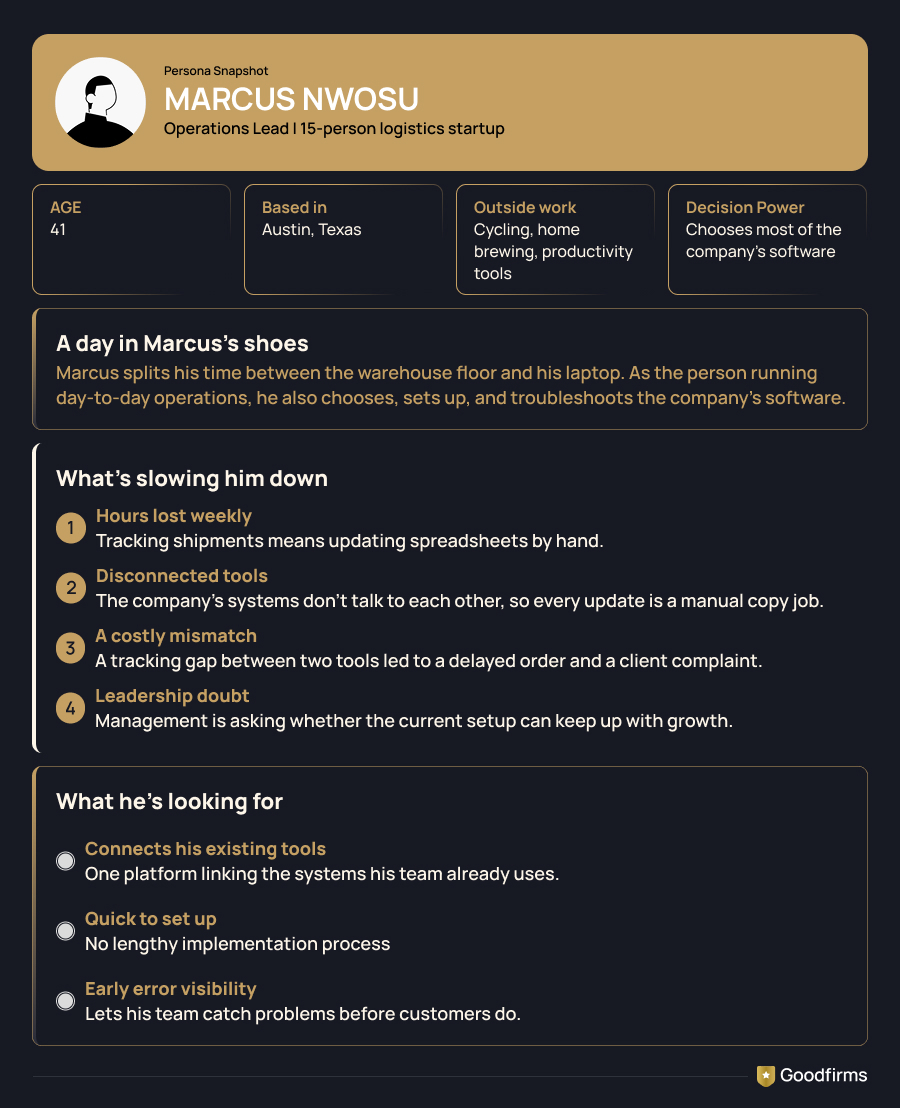
Buyer persona development for social media means creating a fictional representation of your ideal customer based on market research, existing customer data, and interviews. It's an imaginary person who represents what matters most to your broader audience.
Much like an actual customer, it's built around a protagonist, demographics, psychographics, pain points, and decision-making. Telling it as a story rather than a spec sheet makes it more relatable, helps you step into the customer's shoes, and makes it easier to create marketing messaging that genuinely resonates.
Developing a buyer persona, also known as a user persona, marketing persona, or audience persona, is not a hypothetical customer or a growth projection. Rather, the buyer persona already exists within your target market, helping marketing, sales, and product teams make decisions with greater clarity.
Next comes what a persona does for your marketing once you have one.
Why use a Buyer or Audience Persona?
Buyer personas can help you make important decisions about your marketing strategies. It also helps get every member of your team on the same page regarding your marketing and sales strategies. They can also guide your work in sales, customer service, and product development. Ultimately, a buyer persona can help you save time and money by marketing your products or services to the people most likely to use them, rather than trying to reach unresponsive audiences.
Attentive's 2025 survey of 3,300 online shoppers in the US, UK, and Australia found that 81% ignore marketing messages that aren't relevant to them, so relevance has to be planned before the campaign goes live.
A generic persona tells you who buys from you. A social media persona tells you what that person does on the platforms where your ads run. Here's what that changes:
- Targeting: Facebook and Instagram won't let you target "empathetic, career-driven women who value work-life balance." You can target interests, behaviors, connections, and lookalike audiences, so your persona needs to be written in those terms.
- Behavior over demographics: Age and income roughly indicate who to reach. Behavior tells the algorithm who to show your ad to, such as the pages someone follows, when they're online, and what stops their scroll. In Goodfirms' survey of Social Media Advertising: Must-Know User Preferences, 65.23% of users said they engage with ads that match their interests, which is why behavioral fields matter more than age brackets.
- Hidden gaps: Two people can share the same age, job, and income and still respond to completely different triggers. A demographics-only persona won't show you that. Most teams discover it after spending on a few ad sets that went nowhere.
Buyer persona researcher Adele Revella, founder and CEO of the Buyer Persona Institute, points to the most common mistake. In a Wellspring Digital podcast interview, she said the biggest problem with buyer personas is that marketers "start with demographics." Age and job title tell you who to reach. They don't tell you what makes that person act.
We are clear on why personas matter. Here is how to build one, starting with real data and ending with a tested profile.
What is the Step-by-Step Framework for Building a Social Media Buyer Persona?
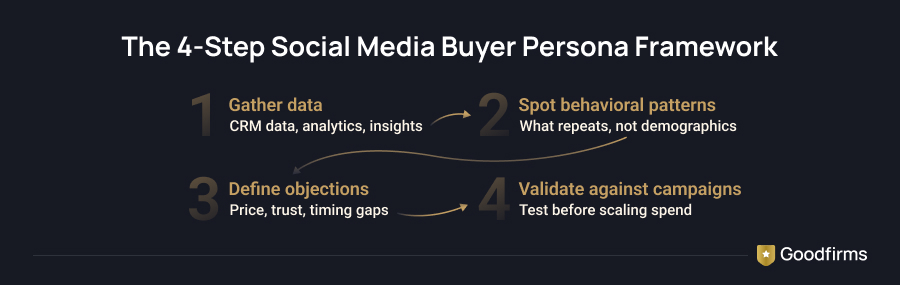
Creating a social-ready persona comes down to four steps that build on each other from raw data to a tested, campaign-ready persona. The right structure turns research into a profile that aligns marketing, sales, and product around one shared view of the customer.
Step 1: Pull real behavioral data first
Start with what people actually do — not what feels true after a few conversations in a meeting room.
- CRM software records (for example, HubSpot or Salesforce): past purchase history and deal notes
- Google Analytics 4: referral source, time on page, device
- Meta Business Suite and Instagram Insights: post engagement, follower demographics, video watch time
- Sales and support notes: the recurring questions, the pushback, the exact words customers use when they're frustrated or unsure
- Customer interviews or survey responses, if they exist
Research provides you with factual data. If gaps exist and there's nothing to fill them, mention it in the brief rather than making guesses or assumptions, as this will mislead you. You may write "probably" or "seems like" and move on, but the gap doesn't go away. If closing that gap matters more than moving fast, market research companies can lend a helping hand.
Step 2: Identify behavioral patterns
Once you have gathered the data, look for what is repeating.
- Which content types actually pull engagement, not just impressions?
- When activity spikes during the day?
- What device are people on when they show up?
- And which platforms your audience is actually active on, versus the ones you keep posting to out of habit, because that's just what's always been done.
Social media management software is usually where this data already lives, so it's worth pulling from there before starting a fresh audit.
Group people by what they do, not the year they were born. "Watches short videos on mobile during commute hours" - A media buyer can target this, unlike "35–44, urban".
Step 3: Define pain points, goals, and objections
For each behavior cluster, be specific mainly about three things:
- What problem are they actually trying to solve the moment your ad shows up
- What outcome do they want, if you can pull that from interviews or support tickets
- What's actually holding them back from buying: price, trust, timing, or just not knowing you exist yet
"Doesn't trust a new brand without seeing reviews first"- this specific objection gives a copywriter something real to write against. "Concerned about quality" - sounds fine in a meeting, but a copywriter can’t play with it for an ad.
The same Goodfirms' survey found LinkedIn is the most trusted platform for ads at 41.54%, compared with 19.69% for Instagram, so an objection like "doesn't trust the brand" can look very different from one platform to the next.
Step 4: Validate against real campaign data
Test persona on a small campaign or check a past one you already have data for. If that audience engaged, clicked, and converted, it's worth more budget.
Suppose it hasn’t, fix the persona before the real budget goes in, not after you've already spent it.
You need to consider the persona as a working hypothesis, not something finished. If anyone tells you theirs is “done,” it's probably just that they haven't checked the numbers lately.
A validated persona is only useful if a platform can act on it. That's where audience targeting comes in.
What is Audience Targeting, and how does it connect to Your Persona?
Audience targeting is the set of criteria a platform uses to decide who sees your ad. A persona is the thinking. Targeting is that thinking, executed within the platform. Every trait in the persona should match a targeting option in your ads manager, either exactly or through a close match, such as a related interest or behavior.
Match each persona trait to a targeting option in three categories:
- Interests and behaviors: the pages, content types, and purchase patterns you found in your research. Example: "Reads industry newsletters and follows three specific software categories."
- Custom and lookalike audiences: built from a specific customer segment, not your full list. Name the source in the brief, because a lookalike from repeat buyers behaves differently from one built on one-time purchasers. Example: "Lookalike built from customers on the lowest-tier plan, to reach price-sensitive prospects."
- Exclusions: people you don't want to pay to reach again, such as existing customers or past leads. Build them as custom audience lists from your own data. Example: "Exclude existing customers from the prospecting audience using a custom audience list."
Traits that don't point to anything, such as "values authenticity," "cares about community," — should either be translated into something concrete or cut from the brief entirely.
Let's apply it to Meta, where most of these campaigns run.
How do you translate a Persona into Facebook/Instagram Ad Audience Targeting?
You can build the audience yourself, category by category, or let Meta's AI suggest options. Most people do a bit of both. Either way, cover all three categories before you brief anyone, because skipping one means relying on gut feel.
1. Interests and behaviors
Take the platforms, pages, and content types you found in your behavioral research and match them to Meta's interest categories. Do the same with purchase behavior: device type, past purchases, travel habits, using Meta's behavior fields.
2. Custom and lookalike audiences
If you have an email list or customer data, upload it as a custom audience, then build a lookalike from your best segment rather than your entire list. Be specific in the persona about which group you're pulling from.
3. Exclusions
Upload your customer list as a custom audience, and add website visitors or past leads if you want them out of prospecting. Then exclude those audiences from your prospecting ad set. Custom audiences are the reliable way to exclude people now, since Meta has scaled back interest- and behavior-based exclusions. Skip this step, and you'll pay to reach people who already know you, and you'll usually only notice when the invoice comes.
Let’s take an example. Say your persona is a small business owner who handles their own marketing, follows accounting and payroll software pages, prefers short explainer videos over long ones, and hesitated on price before. Manually, that becomes: interest targeting on small-business software and accounting; behavior targeting toward small-business owners wherever that field exists; a lookalike sourced from customers on your lowest-tier plan (since price is the known hesitation point); video-first creative; and existing customers excluded via a custom audience.
Each trait maps to a Meta Ads Manager input, though a few belong in the creative brief instead. The last column matters most: Meta treats some inputs as hard controls, others as suggestions it can expand beyond.
|
Persona trait |
What to use in Meta |
Where it lives |
Control or suggestion |
|---|---|---|---|
|
Serves English-speaking small businesses in the US and UK |
Location and language |
Audience controls |
Hard control |
|
Handles their own marketing |
Job or business-owner input, if still available |
Detailed targeting (demographics, interests) |
Suggestion |
|
Follows accounting and payroll software pages |
Interest categories for accounting and payroll software |
Detailed targeting (interests) |
Suggestion |
|
Hesitated on the price before |
Lookalike audience built from lowest-tier plan customers |
Audiences, then Lookalike |
Suggestion |
|
Already a customer |
Customer list uploaded as a custom audience, then excluded |
Audience controls, exclusions |
Hard control |
|
Prefers short explainer videos |
Not a targeting input. Use a short video creative |
Ad creative |
Not applicable |
|
"Values authenticity" |
Not targetable. Cut it or move it to the copy brief |
Not applicable |
Not applicable |
Meta regularly retires targeting options, so search for each interest by name in Ads Manager before adding it to a brief.
Let AI handle the interest matching for you
Instead of hunting through Meta's interest categories yourself, you can describe the same persona in plain language and let Meta suggest the categories. Here's how:
1. Create your campaign. Where available, use Meta’s Advantage+ audience and campaign-budget automation to let Meta optimize delivery and budget allocation based on your campaign goal.
2. Open the Describe Your Audience tab. At the ad set level, go to the Audience section, then Detailed Targeting. Alongside Browse and Suggestions, you'll find Describe Your Audience.
3. Write your persona as a description. Use the same details from your persona document. For instance: "Women aged 25-45 who are interested in sustainable fashion, follow eco-conscious lifestyle influencers, shop online for clothing and accessories, prefer premium brands, are interested in slow fashion movements, and are likely to purchase organic cotton or recycled fabric clothing." The more specific the persona, the better the match.
4. Review what Meta suggests. Click Find Options, and Meta returns a list of interest and behavior categories. Hover over each one to see why it was picked, remove anything off-target, and confirm.
5. Set your hard constraints. In the Advantage+ audience, some settings, such as location and minimum age, are available and can serve as controls that Meta won't expand beyond. Other inputs, such as your interests, work more like signals: Meta may expand beyond them to find additional people. Check Meta's current documentation for your campaign type, since which settings are fixed versus flexible can vary and change over time.
6. Launch and give it room to learn. Finish your ad creative and launch. Give the algorithm at least 7 days before touching targeting again. Check performance daily if you like, but hold off on changes in that first week.
Custom audiences, lookalikes, and exclusions work the same either way. The only difference is who picks your interests and behaviors: you or Meta.
Testing and refining
You may have to run two or three versions of your targeting for the same persona, whether you built the audience manually or with Describe Your Audience. You need to evaluate them on cost per result and engagement quality, not reach. Whatever works best, add that into your persona document for the next campaign.
Once your main targeting is set up, your persona work may point to smaller groups that a broad audience would overlook.
How can Niche Audience Targeting Reach Underserved Segments?
Niche audience targeting focuses on small, specific groups defined by real behaviors and interests, rather than aiming for a broad, general audience. When done well, it builds stronger connections and drives higher conversion rates, simply because the efforts cater to what that particular group actually cares about.
The best niche segments usually come from your pain-point work: a subgroup with an objection or use case the rest of your audience doesn't share, like customers already using a competitor but frustrated with their support. A broad "interested in [category]" audience will quietly swallow that group.
Broad targeting works when the product has a wide appeal, and the algorithm has room to learn. Narrow targeting works when the persona surfaces a specific, underserved behavior — a distinct job function, a specific point in the buying cycle, an objection unique to one segment.
To make niche targeting work:
- Segment by behavior and mindset, not just age or location, so each group gets messaging that fits.
- Write to one segment at a time, not a generic version of your audience.
- Follow the journey, not just the click. Identify who is closest to acting and build campaigns around that group first.
However, niche audiences burn out faster and get pricier as frequency climbs, even though they convert more predictably. Keep them running with a smaller budget, use broad campaigns for awareness, and use what you learn from niche campaigns to improve your broader audience over time.
Whether you go broad, niche, or both, the next step is to put it all into a brief someone else can run with.
How to Turn Your Persona into an Agency-Ready Brief
A persona only proves its worth once someone outside your head can pick it up and act on it without a follow-up call. That means structuring it like a brief, not a story.
1. Persona summary. Keep it to one page. Behavior clusters, top three pain points, the main objection, preferred platforms, and formats.
2. Targeting parameters. List the interests, behaviors, custom audience sources, and exclusions from your persona. Mark, which segments are niche and which suit broader campaigns?
3. KPIs. Pick the one metric for this persona's stage in the funnel — cost per result, click-through rate, conversion rate, ROAS.
4. Budget. Give a real range, split between testing and scaling, and between niche and broad spend if both are in play.
Once the brief is built, put it to work. Ask the agency directly:
- How would you translate this persona's behavior data into targeting fields on Meta?
- Which parts of this persona aren't targetable as written, and how would you fix that?
- How do you decide between a niche segment and a broader audience for a persona like this one?
- What does your validation process look like once the campaign is live?
If you get generic answers instead of ones on your brief, move on to the next.
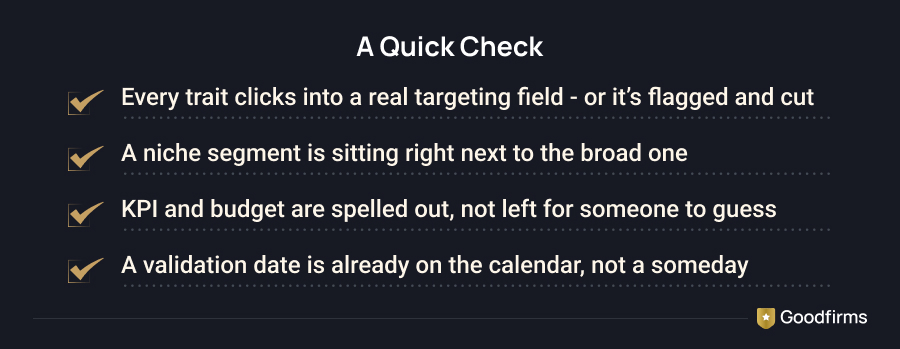
But before sending, make sure nothing is missing. So, do a quick check.
Checklist Before Sending the Brief
Once your persona is ready, use this checklist before finalizing it.
Keep Your Personas from Falling Behind Your Business
A persona is only as good as the last campaign it was tested against. When your audience shifts or your business changes direction, update the persona before you plan the next campaign around it, not after the results come in.
Using buyer persona development for social media helps you target sharply, message relevantly, and allocate your budget to people who are actually going to convert in the first place. Persona work is just a slice of the cake. For the rest, Goodfirms' guide to Difficult Yet Effective Digital Marketing Tactics breaks down what else contributes to a strategy that needs sharpening beyond targeting alone.
FAQ- Buyer Personas for Social Media: A Step-by-Step Framework
Where can I find affordable social media marketing services that actually deliver results?
The most reliable place to start is a review platform like Goodfirms, where you can compare social media marketing agencies by services, budget, and verified client reviews in one place. That's faster than cold outreach or sitting through pitch decks to find out who's worth a call.
How many buyer personas does a brand need?
Somewhere between one and four active personas is typical, each built around a genuinely different behavior cluster — not one for every small variation you can think up. If the number exceeds, the briefing gets messy, targeting overlaps, and your ad sets end up competing for the same budget.
How often should personas be updated?
Update your persona as soon as your campaign data shows it no longer matches how people actually behave. If that hasn't happened, review it at least once a year, since platform behavior changes even when your product doesn't.
What's the difference between a buyer persona and an audience segment?
A persona explains the "why" behind a purchase. An audience segment is the specific, targetable group you actually build inside a platform to reach that person. One persona can turn into several segments — a broad one and a few narrower ones, each built around a different objection.
Can one persona work across multiple social platforms, or do I need a separate one for each?
One persona can usually cover multiple platforms, as long as the behavioral data holds up on each platform. What changes is the targeting layer underneath it — the interest fields, creative formats, and even the objections you lean on might shift between, say, Instagram and LinkedIn, even though the underlying person is the same. Build the persona once, then adjust the execution per platform rather than starting from scratch each time.


.jpg)