Courting TikTok for your beauty brand? Makes sense. But if you sell B2B software, your buyers might be looking somewhere else entirely.
Here’s the twist: 41% of Gen Z turn to social platforms first when they need information. And as of April 2026, social media had 5.79 billion active user identities worldwide. That’s a huge crowd—but a huge crowd won’t help if your buyers aren’t in it.
So, which platforms deserve your time and budget? Let’s look at the 2026 social media statistics: who’s using what, how they’re using it, and what that means for your brand.
Key Social Media Statistics and Facts for 2026
- Social media accounted for approximately 5.79 billion active user identities worldwide in April 2026, equal to 69.9% of the global population. Datareportal
- The global total increased by 294 million identities, or 5.4%, over the preceding 12 months.
Facebook remains the largest conventional social network by reported monthly active users, with more than 3 billion. Statista
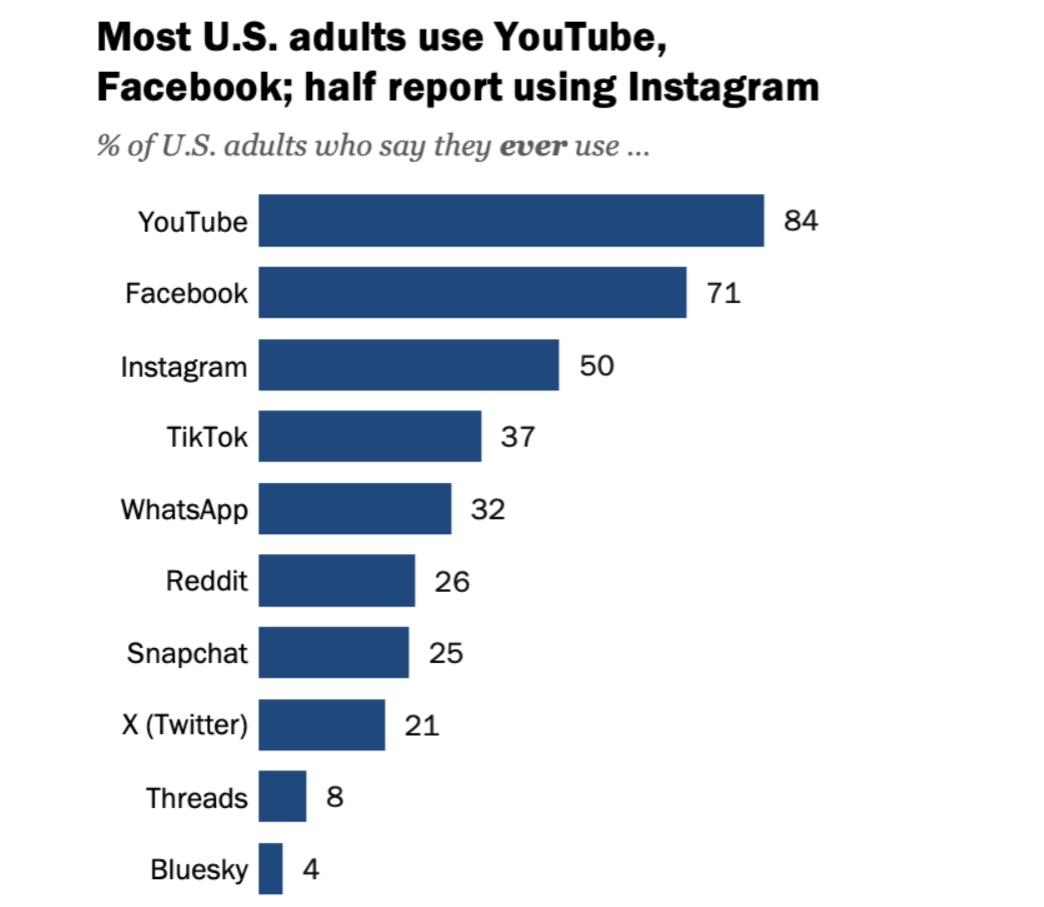
- YouTube is used by 84% of US adults, making it the most widely used platform. Pew Research Center.
- Facebook is used by 71% of US adults, while Instagram reaches 50%. Pew Research Center
- Reddit reported 126.8 million daily active uniques in the first quarter of 2026, up 17% year over year. Source
- Platform size does not equal platform fit: YouTube and Facebook provide broad reach, while Instagram, TikTok, LinkedIn, Reddit, and messaging apps serve more distinct audience behaviors.
- “Users,” “user identities,” “registered members,” “advertising reach,” and “daily active users” are distinct metrics and should not be compared as if they're the same thing.
That last point matters more than it seems. There's more to social media stats than meets the eye, because every platform reports different metrics. A LinkedIn "member" count includes everyone who's ever signed up, active or not. A Reddit "daily active user" count only includes people who logged in today. Comparing the two is like comparing apples and oranges. The same goes for platform-reported numbers — an ad-reach estimate may include duplicate accounts, inactive profiles, and overlapping audiences, and it isn't a verified monthly active user count (official or audited).
Most Popular Social Media Platforms in 2026
Facebook, though one of the older social media platforms, is still the heartbeat of billions. The table below therefore uses the latest widely reported figures and labels the measurement wherever possible.
| Platform | Latest reported audience size | Avg. Time Spent/Day | Growth Driver |
|---|---|---|---|
|
3.07 billion |
31–52 min | Daily engagement, mobile dominance | |
|
3.0 billion |
25–30 min | Messaging/calling, Channels adoption | |
|
2.0 billion |
38–63 min | Reels, short-form video, creator economy | |
| YouTube |
2.7 billion |
49–79 min | Long-form video, connected TV, subscriptions |
| TikTok |
2 billion |
54–96 min | Short-form viral video algorithm |
|
1.41 billion |
Not consistently reported | All-in-one ecosystem (Asia) | |
|
1.3+ billion registered members |
7–17 min | Professional networking, B2B content, hiring | |
| Telegram |
~1.0 billion |
Not consistently reported | Large-scale broadcast channels, communities |
| 514.6 million weekly active users (Q2 2026) source | Interest-based communities, discussions, and search discovery |
As you can see, Facebook is leading the pack if you go by the raw user count, but the platforms gaining the most ground, be it Instagram, TikTok, or YouTube, are built around video-first formats. Younger users, it goes without saying, gravitate to visual, video-driven platforms, while older demographics remain loyal to traditional networks like Facebook.
How Social Media Usage Breaks Down by Generation
Gen Z and millennials have a multi-platform routine around video, messaging, creators, and social search. However, for older users, less is more. They tend to focus their attention on fewer, more established platforms such as Facebook and YouTube. But make no mistake. Older adults may use fewer platforms, but they are still active on social media. In the US, more than half of adults aged 65 and older use Facebook and YouTube.
| Generation (Age Group) | Daily Time Spent | Top Platform Priorities | Search Behavior |
|---|---|---|---|
| Gen Z (13–28) | 3h 40m | YouTube (91%), Instagram (86%), TikTok (79%), Facebook (77%) | 41% use social search (TikTok/Instagram) over Google |
| Millennials (29–44) | 2h 15m | YouTube (90%), Facebook (89%), Instagram (81%), TikTok (69%) | Usage spans entertainment, communities, product research, and messaging |
| Generation X (45–61) | 1h 45m | Facebook (88%), YouTube (83%), Instagram (60%), TikTok (46%) | Practical information, groups, professional content, and video all matter |
| Baby Boomers (62+) | 1h 00m | Facebook (88%), YouTube (69%), Instagram (39%), TikTok (20%) | Smaller platform set, but strong research intent and purchasing power |
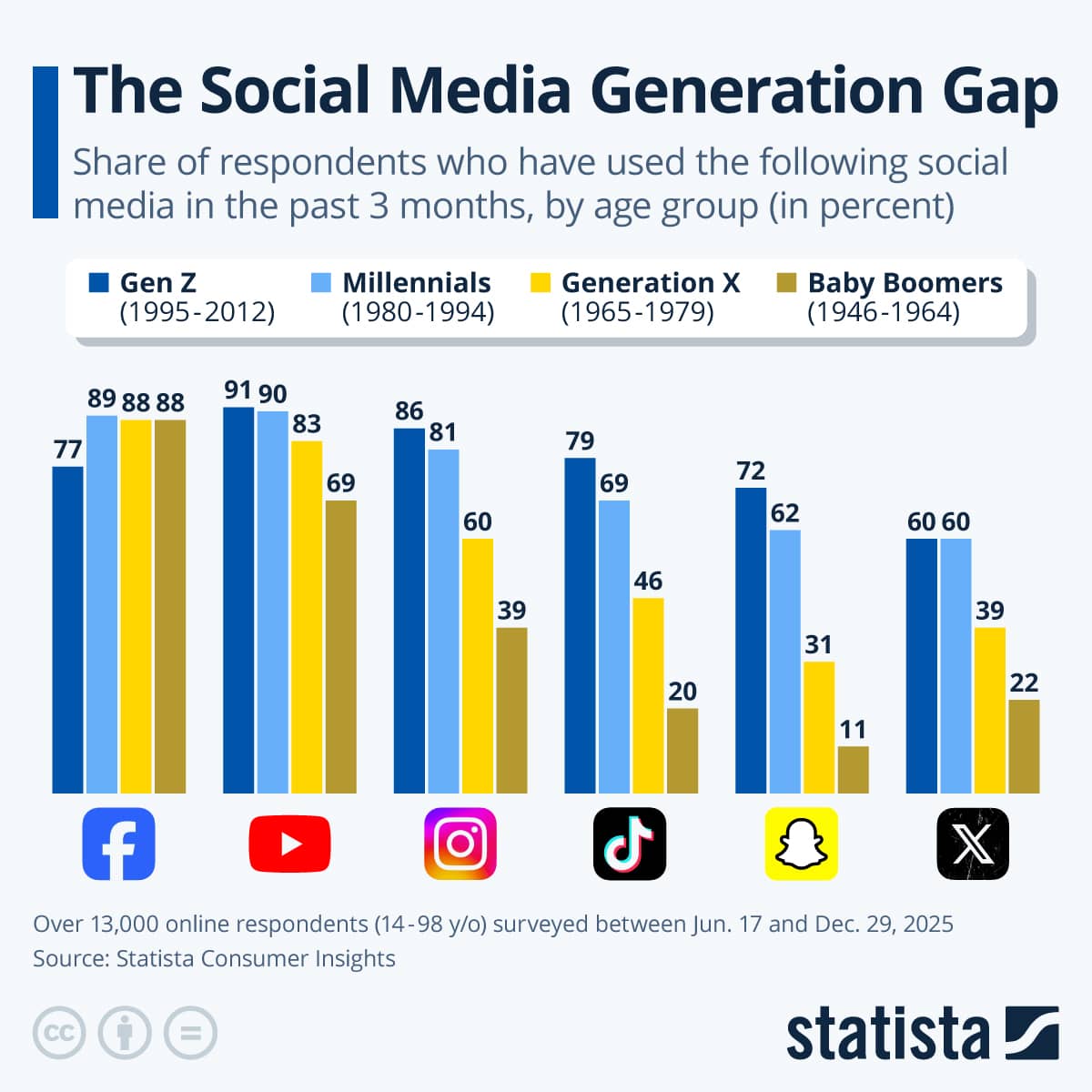
Sprout Social’s study reinforces the split. YouTube and Facebook are popular across all age groups, while Instagram, TikTok, Snapchat, and Reddit are more popular with younger adults.
The useful takeaway is not that every Gen Z buyer lives on TikTok or every older buyer lives on Facebook. It is that the same content journey can begin in very different places. One person may discover a brand through a short video, verify it through search, read comparisons on Reddit, and contact the company through WhatsApp or LinkedIn.
Funnels did not disappear. They became harder to see. Social Media Usage in the United States vs. Worldwide
Social Media Usage in the United States vs. Worldwide
Global social media usage averages can mislead US-based teams because platform habits are not the same in the US.
According to Pew Research Center, 84% of US adults use YouTube, 71% use Facebook, and 50% use Instagram. Not to mention, smaller—but still substantial—shares use TikTok, WhatsApp, Reddit, Snapchat, and X.
Worldwide, the balance shifts. WhatsApp operates as a default communication layer across much of Latin America, Europe, Africa, and South Asia. WeChat plays an ecosystem-level role in China. Telegram is more prominent in several international markets than its visibility in the US suggests.
| Market view | Platforms that stand out | Strategic implication |
|---|---|---|
| United States | YouTube, Facebook, Instagram, TikTok, Reddit | Video, communities, and creator content have broad marketing relevance |
| International markets | Facebook, WhatsApp, Instagram, YouTube, WeChat, Telegram | Messaging and direct customer communication become more important |
| B2B audiences | LinkedIn, YouTube, Reddit, specialist communities | Expertise, proof, comparison, and professional context matter more than raw reach |
This is a common blind spot. For example, a US brand might make Facebook Messenger its main customer support channel. If it copies that approach in India, it could miss customers who prefer to contact businesses via WhatsApp. The right channel depends on how people communicate in the market you’re targeting.
China also has one of the world’s largest connected populations, but many global platforms are restricted. Domestic ecosystems such as WeChat, Douyin, Weibo, and Xiaohongshu therefore carry far more weight than a conventional global platform ranking suggests.
India represents one of the world’s largest social media markets. According to Data Portal, India had approximately 500 million unique social media users. When it comes to YouTube, India has the largest audience globally with 518 million users, which reinforces its position as the world’s second-largest search engine after Google. The same goes for Instagram. India has the largest Instagram market in the world with 551 million users.
The country’s low mobile-data costs and enormous smartphone base make it strategically important for platforms and advertisers alike.
The United States has a smaller user base than India or China, but remains one of the most valuable advertising markets because of its purchasing power and mature digital ad ecosystem.
Brazil and Indonesia, meanwhile, combine large connected populations with heavy use of video, messaging, and social commerce.
For campaign planning, penetration rate and audience fit are often more useful than total users. A country with a smaller population but near-universal social adoption may offer a more reachable audience than a larger market with uneven access.
Social Media Demographics by Platform
Facebook demographics
If you are planning to write off Facebook as an old-user platform, then better stop yourself in your tracks. Currently, Facebook has about 3.07-3.22 billion monthly users, making it the largest social media platform globally.
The biggest plus: Right now, it has 2.11 billion daily users, a 5.5% year-over-year increase, according to Search Engine Land. The platform is still frequented by Millennials and GenX and is known for its dependable reach when it comes to community building, marketplace activity, local discovery, and advertising infrastructure.
YouTube demographics
YouTube may be the No. 1 social media platform in the US, with 84% of adults using it (254 million), but India, thanks to its population advantage, has 518 million users. Globally, YouTube ranks fourth among the most-used social media platforms, with Facebook, WhatsApp, and Instagram ahead of it.
The biggest plus: YouTube is unusually resilient across generations. Younger audiences may arrive for creators and entertainment; professionals may arrive for reviews, tutorials, and technical explanations; older audiences may use it as their primary digital-video platform.
Instagram demographics
Instagram is the most popular platform in India, with 551 million users. United States (179.9 million), Brazil (147 million), Indonesia (109 million), and Japan (61.6 million) also have a good number of users.
The biggest plus: People spend an average of 33.9 minutes a day on Instagram. And the platform is no longer a photo-first app. Reels, stories, and direct messages support conversation, ongoing audience engagement, and shopping features that guide users from content to products.
If your brand is in fashion, travel, food, beauty, fitness, and more, Instagram can help you with photos, videos, and creators.
TikTok demographics
TikTok creators mainly fall in the 18 to 24 age group. But 4 in 10 TikTok users are aged 25-34, indicating the platform's audience is broadening.
The biggest plus: Algorithm-led discovery, short-form vertical video, creator-native storytelling, and comment sections function as public product research. The platform’s influence therefore exceeds its own user count. Reels, Shorts, and even B2B video formats have absorbed the grammar TikTok helped popularize.
LinkedIn demographics
LinkedIn is rarely the largest platform in a general statistics roundup, but it is one of the most relevant for B2B marketers. Its audience arrives in a professional context: to learn, hire, sell, build credibility, follow companies, and evaluate expertise.
The biggest plus: That context is the advantage. A smaller professional audience can be more commercially valuable than a larger entertainment audience when the product is software, consulting, recruiting, finance, or another considered B2B purchase.
Reddit demographics
The platform reported 126.8 million daily active uniques in Q1 2026, up 17% year over year. For marketers, the important point is not simply that Reddit is growing. It is that search engines and AI systems increasingly surface
Reddit discussions when people seek lived experience, objections, and peer opinion.
Reddit is organized around interests rather than personal networks. Its communities are where users ask highly specific questions, compare products, troubleshoot problems, and look for answers that feel less polished than a brand’s landing page.
WhatsApp, Snapchat, Pinterest, X, and other platforms
These platforms serve different jobs and should not be bundled into an “other” bucket during planning.
✔ WhatsApp is central to messaging, customer service, community groups, and conversational commerce in many international markets.
✔ Snapchat remains relevant for younger audiences and private, camera-led communication.
✔ Pinterest functions less like a conversational network and more like a visual discovery and planning engine, particularly for lifestyle and purchase-oriented categories.
✔ X remains influential in news, politics, technology, finance, and live commentary, even though its overall audience is smaller than the largest consumer networks.
✔ Threads and Bluesky reflect continued demand for text-led public conversation, but their strategic value depends heavily on industry, geography, and audience overlap.
Where People Discover and Research Brands
The popular narrative says social media has replaced search. The data says the shift is real—but not that simple.
DataReportal’s 2026 global reporting continues to show search engines, television advertising, and social media advertising among the leading sources of brand discovery. AI tools are growing as research interfaces, but they have not erased search, social, video, or review-led discovery.
The more accurate picture is a blended journey:
1. A buyer encounters a problem or product through social content.
2. Search, YouTube, Reddit, review platforms, or AI tools provide context.
3. The buyer checks proof: reviews, pricing, comparisons, examples, and expert opinion.
4. A messaging app, form, marketplace, social profile, or sales conversation closes the gap.
That is why brands should be cautious about treating social and search as rival channels. Social creates attention and repeated exposure. Search captures explicit demand. Reviews reduce uncertainty. Good content connects the three.
Social Commerce and Creator Economy Statistics
Social platforms have spent years trying to reduce the distance between “I saw it” and “I bought it.” The result is a mix of advertising, affiliate commerce, platform storefronts, subscriptions, tipping, branded content, and revenue sharing.
Three models dominate:
1. Targeted advertising. Platforms sell access to audience attention through auction-based CPM, CPC, video-view, or conversion campaigns.
2. Social commerce. Shopping tools, affiliate links, product tagging, and in-app checkout connect content with transactions.
3. Creator monetization. Creators earn through advertising shares, subscriptions, tips, affiliate commissions, brand partnerships, and direct product sales.
The creator economy is important here, but it should not be mistaken for a single, predictable job market. Platform payouts change. Eligibility rules differ by country. Brand deals vary wildly by niche, audience quality, and negotiating power. Many successful creators therefore operate a stack rather than depending on one source of income: short-form content for discovery, long-form content for depth, partnerships for revenue, and owned channels such as email or communities for stability.
That approach is not just good creator advice. It is good brand strategy too. Renting all of your audience access from one algorithm is convenient—right up until the algorithm changes.
What These Social Media Statistics Mean for Marketers
The numbers point to five practical conclusions.
1. Reach is not the same as relevance
The largest platform is not automatically the best platform. Audience intent, content format, geography, and buying context matter more than a league table of user counts.
2. Video is a format, not a complete strategy
YouTube, TikTok, Instagram, Facebook, and LinkedIn all reward video, but users do not arrive on each platform with the same expectations. A video should be adapted to the viewing context, not merely resized.
3. Search and social increasingly overlap
People search TikTok, YouTube, Reddit, LinkedIn, Instagram, marketplaces, review sites, AI tools, and Google for different kinds of answers. Discoverability now depends on being useful across that wider research journey.
4. Global strategies need local platform logic
WhatsApp, WeChat, Telegram, and region-specific platforms can matter more than a US-centric channel plan suggests. Country-level behavior should be checked before budget is allocated.
5. B2B brands should not copy consumer playbooks blindly
LinkedIn, YouTube, Reddit, expert communities, reviews, and search often carry more decision-making weight for a considered B2B purchase than a high-reach entertainment post. B2B content still needs personality, but it also needs evidence.
Businesses that need outside support can compare verified social media marketing companies by expertise, reviews, portfolios, and pricing. Teams managing campaigns internally can also explore social media management software for publishing, monitoring, engagement, and reporting.
FAQs - Social Media Statistics
What percentage of the world uses social media in 2026?
Active social media user identities were equivalent to approximately 69.9% of the global population in April 2026. User identities do not necessarily represent unique individuals because one person may operate multiple accounts.
How many social media users are there in 2026?
DataReportal reported approximately 5.79 billion active social media user identities worldwide at the start of April 2026.
What is the most popular social media platform in 2026?
Facebook remains the largest conventional social network by reported monthly active users, with more than 3 billion. However, YouTube has the broadest measured reach among US adults, while WhatsApp and Instagram also operate at enormous global scale.
Which social media platform is most popular in the United States?
YouTube is the most widely used platform among US adults. Pew Research Center found that 84% of US adults use YouTube, compared with 71% for Facebook and 50% for Instagram.
Which generation uses social media the most?
Younger adults typically use a wider mix of social platforms and are particularly active on YouTube, Instagram, TikTok, Snapchat, and messaging apps. However, Facebook and YouTube maintain meaningful reach across older age groups as well.
How much time do people spend on social media each day?
Global estimates generally place average daily social media use at roughly two and a half hours. The exact figure varies by country, age, device, and research methodology.
Is TikTok replacing Google for younger users?
TikTok, Instagram, YouTube, and Reddit increasingly function as search and discovery platforms, particularly for younger audiences. But they have not replaced conventional search across all queries. People frequently use social platforms for inspiration and lived experience, then use search engines, reviews, or other sources to verify the decision.
Is Facebook still relevant in 2026?
Yes. Facebook is used by 71% of US adults and remains one of the world’s largest social networks. Its strongest roles include broad adult reach, groups, events, local discovery, Marketplace, and advertising.
Is LinkedIn important for B2B marketing?
Yes. LinkedIn’s professional context makes it particularly relevant for thought leadership, hiring, vendor discovery, account-based marketing, and considered B2B purchases. Its commercial value should not be judged only by comparison with the user totals of consumer entertainment platforms.
Should a business be active on every social media platform?
No. Businesses should prioritize the platforms where their target audience actively discovers, evaluates, or discusses products. A focused presence supported by the right content and measurement is generally more useful than maintaining weak profiles everywhere.