Key takeaways
- Revolut Bank UK Ltd became a fully licensed UK bank on 11 March 2026, regulated by the PRA and FCA.
- Before this, Revolut was an e-money company, meaning customer funds were kept safe but not protected under the FSCS.
- Crypto and stock trading still run through separate Revolut entities and are not covered by the banking license or FSCS protection.
- Revolut's journey is part of a bigger trend; more neobanks and fintechs are going after full banking licenses instead of staying lightly regulated.
Is Revolut a bank? As of March 2026, yes. Revolut Bank UK Ltd now holds a full UK banking license, regulated by the PRA and FCA, the same bodies that oversee every high street bank. Sounds confusing? Let's start from the beginning.
Before this, Revolut ran as an e-money company, not a bank, so customer money was kept safe but not protected the way a bank legally has to protect it. That difference mattered more than most people realized. Here's what actually changed, how Revolut's crypto and trading features fit in, and what this shift says about where neobanks and fintechs are headed. Revolut has now made the jump and become a fully licensed bank.
Looking to understand how a company gets from app-based fintech to a real bank? Consult neobank development vendor recipe specialists to learn how it's done.
The bigger story: what Revolut was before, and what changed
For years, Revolut did not operate as a licensed UK bank. Instead, it operated under an electronic money institution (EMI) license, a lighter form of authorization. This let it hold and move customer money, but it sat outside the full banking rulebook. This is also why Revolut got called a neobank, an app-only company that acts like a bank but doesn't hold a full banking license. Its crypto trading, which has always run through a separate part of the business, wasn't affected by any of this and still isn't part of the new bank today.
Under the old setup, customer funds were "safeguarded." That means the money was kept separate from Revolut's own funds, so it couldn't be used for business expenses. But safeguarding isn't the same as the legal protection a real bank has to give you.
Getting a full Revolut Bank UK license took almost five years. Here's the timeline in simple terms:
|
Date |
What happened |
|---|---|
|
2021 |
Revolut applies for a UK banking license. |
|
July 2024 |
The PRA grants a restricted license. Revolut enters a "mobilization phase" and is capped at £50,000 in total customer deposits, standard for a new bank still setting things up. |
|
April 2025 |
Revolut pays a €3.5 million fine to Lithuania's central bank over anti-money laundering failures. |
|
August 2025 |
Revolut switches auditors, from BDO to EY, seen as a move to clean up its financial reporting image. |
|
11 March 2026 |
The PRA removes all restrictions. Revolut Bank UK Ltd officially launches. |
The mobilization phase alone lasted over 20 months, longer than the usual 12-month window. Regulators pointed to governance and compliance concerns as the reason for the delay.
So what does this actually mean if you have a Revolut bank account today? Here's the simple version, laid out side by side:
|
Before March 2026 |
After March 2026 |
|---|---|
|
E-money account, funds safeguarded |
Bank account, funds FSCS-protected |
|
No FSCS protection |
Protected up to £120,000 |
|
No lending or credit products in the UK |
Lending and credit are now possible |
|
Account number and sort code |
Same account number and sort code |
|
Crypto trading via a separate entity |
Crypto trading is still via a separate entity, unchanged |
A few extra things worth knowing:
- Accounts are moving to the new bank entity in batches, and you'll get at least two months' notice before yours moves.
- If you sign up after March 2026, you might still start on an e-money account, so it's worth checking your account type in the app if FSCS protection matters to you.
In short, the app itself barely changes. What changes is the legal protection sitting behind your money, and, on paper at least, Revolut is moving from "neobank" to "bank."
Is Revolut a Neobank, a Fintech, or a Bank?
Honestly, it's been all three at different points, and that's exactly what makes this story interesting. Here's how Revolut fits into each label.
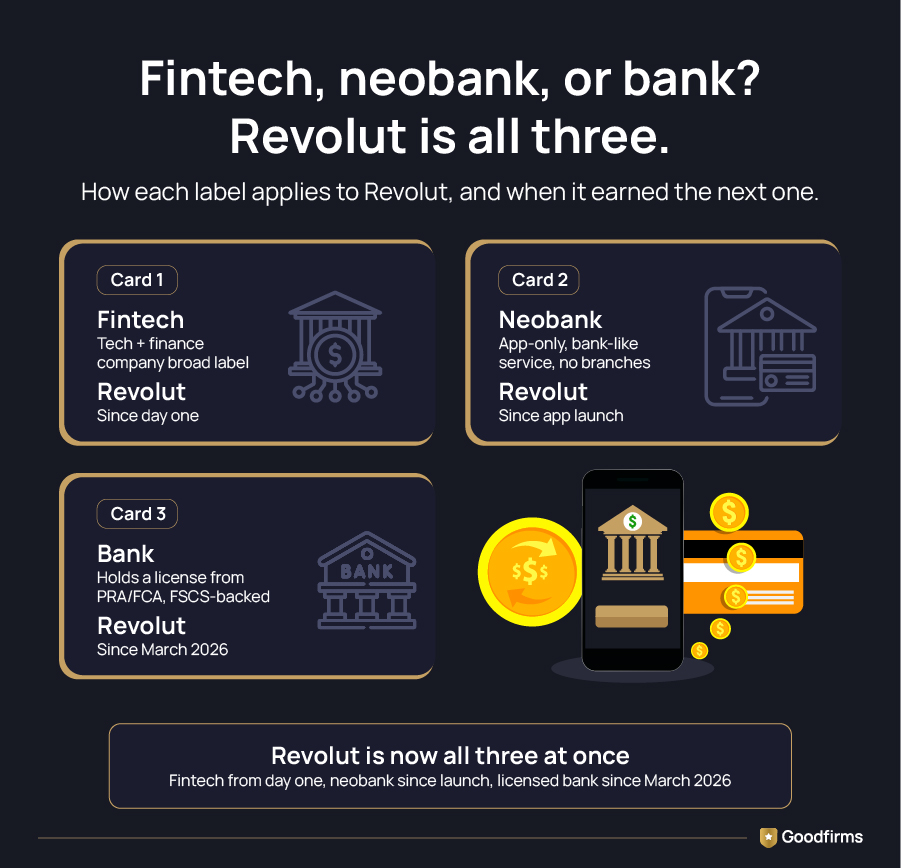
Revolut started life as a fintech, a company using technology to offer financial services. That's the widest label, covering everything from payment apps to budgeting tools to crypto exchanges, and it's still true of Revolut today.
As it grew, Revolut became known as a neobank: Some neobanks, including Monzo and Starling in the UK, and N26 and bunq in Europe, hold full banking licenses of their own. Others operate under lighter e-money licenses and partner with a licensed bank behind the scenes. Until March 2026, this is where Revolut sat. Like most neobanks, it didn't hold its own banking license, so customer money was safeguarded rather than fully protected the way a bank's is.
Now, with its full UK license, Revolut has become an actual bank too, a company holding a real license from the PRA and FCA, with the obligations that come with it: capital requirements, FSCS-backed deposit protection, and the ability to lend.
What makes Revolut unusual is that it's kept all three labels at once. It's still a fintech at its core, still runs like a neobank in the app, but is now also a fully regulated bank behind the scenes. While several fintechs, including Monzo, Starling, N26, bunq, and Klarna, have successfully made this transition, obtaining a banking license remains a lengthy and highly regulated process.
Building the app itself is only one piece of that journey; licensing, compliance, and banking infrastructure are separate tracks entirely. If you're at the app-building stage of a similar product, a team experienced in neobank app development can help you get that part right.
Where crypto and blockchain fit into Revolut
This is where most of the confusion around Revolut comes from, so let's be direct about it: Revolut's crypto and stock trading features run through a completely separate company from Revolut Bank UK Ltd. Becoming a bank didn't bring crypto under PRA supervision, and it doesn't extend FSCS protection to any crypto you hold on the app.
In plain terms:
- Money in your Revolut bank account is protected up to £120,000 under the FSCS.
- Crypto held in the same app is not a banking product and has no such protection. It works more like holding assets on any other crypto exchange.
This split isn't unique to Revolut. It's common across the industry, and it's part of why Revolut keeps crypto structurally separate from its banking business. Companies offering cryptocurrency exchange development work usually build things this way, too, mainly because crypto rules and banking rules are still governed very differently in most countries.
Elsewhere, companies like Circle and Ripple have gone after full banking or trust charters in the US, and platforms built as a cryptocurrency exchange platform are increasingly expected to clearly separate custody, trading, and anything banking-adjacent, whether or not they hold a banking license themselves.
How Revolut compares to other Neobanks
Revolut isn't the only digital-only bank in the UK; several other neobanks have been around for years and already hold full banking licenses. Most of them took the more traditional route: get licensed early, then build out features over time. Revolut did the opposite. It grew a massive user base first, on the strength of multi-currency accounts, budgeting tools, and crypto trading, and only secured full banking status years later.
That difference in order matters. Neobanks that launched as licensed banks from day one have generally offered FSCS-backed protection and lending products for longer. Revolut is now catching up on that front, but it's still ahead of most competitors when it comes to crypto access and multi-currency features, since those remain part of its offering in a way most fully-licensed neobanks don't match.
In short, Revolut's path shows that there's more than one way to grow into a full bank, either lead with regulation and build features later, or lead with features and catch up on regulation. Both approaches exist in the neobank space today, and Revolut is one of the clearer examples of the second.
Conclusion
So, is Revolut a bank? Yes, as of March 2026, it's a fully licensed one, regulated the same way as any other UK bank, with FSCS-backed protection now behind eligible customer funds.
What hasn't changed is the crypto side of the app, which still sits completely outside the banking license. The bigger point here isn't really about Revolut alone. It's a sign that the neobank and fintech model is growing up, and that full banking status, once optional, is becoming the standard that ambitious fintechs eventually work toward.
FAQ's - Is Revolt a Bank
1. Is Revolut a real bank now?
Yes. Since 11 March 2026, Revolut Bank UK Ltd has been a fully licensed bank in the UK, regulated by the PRA and FCA, the same two bodies that oversee Barclays, HSBC, and every other major UK bank. Before this date, Revolut operated under a different type of license that didn't offer the same protections.
2. Is my money protected if Revolut fails?
It depends on your account type. Once your account has moved to Revolut Bank UK Ltd, eligible deposits are protected up to £120,000 under the FSCS, the same scheme that protects money at any UK bank. If your account hasn't moved yet and is still under the older e-money setup, your funds are kept safe, but don't have that same FSCS backing. Checking your account status in the app is the easiest way to know which applies to you.
3. Does this affect crypto held on Revolut?
No. Crypto trading on Revolut runs through a completely separate company, not through the new bank. That means crypto holdings aren't covered by the banking license and don't get FSCS protection. If the value of your crypto matters to you, it's treated more like holdings on any other crypto exchange, not like money in a bank account.
4. Is Revolut a good bank?
For everyday spending, budgeting tools, and moving money between currencies, Revolut is generally well-rated by its users. Now that it holds a full banking license, it also matches traditional banks when it comes to deposit protection, which is something it couldn't offer before. Whether it's "good" for you specifically depends on what you need from a bank, but the safety net is now the same as any other UK bank.
5. What's the difference between a neobank and a fintech?
A fintech is any company that uses technology to deliver financial services; it's a broad umbrella. A neobank is a more specific type of fintech: a digital-first, app-based bank or financial institution. Some neobanks, like Monzo and Starling, hold full banking licenses of their own; others operate under lighter e-money licenses instead. Revolut is unusual because it's now both a neobank in how it looks and feels, and a fully licensed bank in how it's regulated.
6. Do I need to do anything to switch to the new bank account?
No, nothing on your end. Revolut is moving accounts over in batches and will give you at least two months' notice before your account is switched. Your account number and sort code won't change, so payments, direct debits, and salary deposits will keep working as normal.
7. Why did it take Revolut so long to become a fully licensed bank?
Revolut first applied for a UK banking license back in 2021 but didn't get full approval until March 2026, nearly five years later. Part of the delay came from an extended "mobilization phase" that ran well past the usual 12 months, along with regulatory concerns around anti-money laundering compliance and financial reporting that Revolut had to work through first.
8. Will Revolut's fees or features change now that it's a bank?
Day-to-day fees and features are staying largely the same for now. What's new is that Revolut can offer products it legally couldn't before, like lending and credit, since those require a full banking license. Over time, expect to see Revolut roll out more bank-style products, but the core app experience customers are used to isn't changing overnight.