Key takeaways
- Ranking alone no longer gets you recommended. ChatGPT reads a handful of product pages and recommends two or three directly, so if you're not one of them, you don't exist for that shopper.
- Visibility starts with crawler access, not content. A blocked OAI-SearchBot is the most common reason stores go unseen, before any content or feed work even matters.
- Trust is built off-site now, too. Reviews, consistent brand details, and mentions on Reddit and comparison sites are what turn a well-optimized listing into a recommendation.
- According to Salesforce's Fourth Edition State of Commerce report, use of agentic search as the first step in the shopping journey grew 200% year over year — meaning more buyers are opening ChatGPT before they open Google.
When shoppers search for a product on ChatGPT, it doesn’t return ten blue links as Google does. It reads a handful of product pages, compares what they say, and recommends a few options. If your product isn't being recommended, your store doesn't exist for that shopper. A ChatGPT ecommerce SEO strategy helps stores appear in those search conversations, whether you run it in-house or bring in digital marketing companies to handle it.
A ChatGPT ecommerce SEO strategy comes down to eight things:
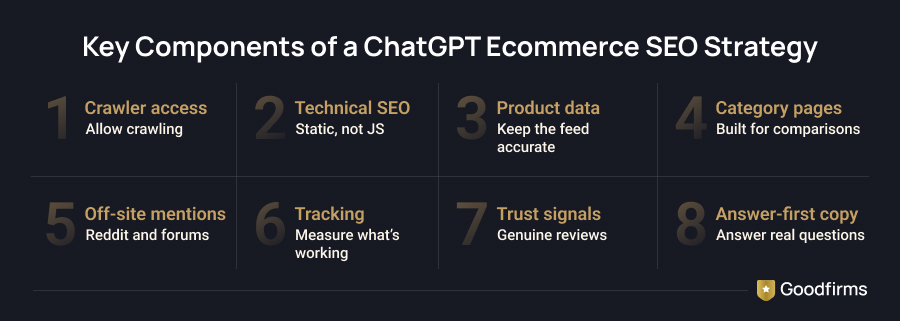
This guide breaks down the strategy and the changes in how ChatGPT handles shopping in 2026.
Ready to get found by ChatGPT, not just Google? Browse eCommerce SEO companies on Goodfirms.
What does a ChatGPT Ecommerce SEO strategy involve in 2026?
A ChatGPT ecommerce SEO strategy makes your products easy for ChatGPT to find, read, and trust. It builds on the technical SEO basics you already handle, whether in-house or through an SEO company, to help you rank on Google.
Adobe Digital Insights found that traffic from AI sources to U.S. retail sites grew 393% year over year in Q1 2026. By March, that traffic was converting 42% better than traffic from non-AI sources, a significant change from a year earlier, when it was converting 38% worse.
The shift shows up on the shopper's side, too. Use of agentic search as the first step in the shopping journey grew 200% year over year, according to Salesforce's Fourth Edition State of Commerce report.
For starters, agentic search is an AI-powered way of product discovery where you state your needs, and the system interprets your natural-language intent against live retailer inventory. It then curates a tight shortlist of the best matches or handles the checkout for you.
Goodfirms insight: Vendors are responding to the same shift. Goodfirms has reviewed 34,310 SEO companies and 16,786 eCommerce development companies as of September 2026, and AI visibility is now a service many of them list. Senate Marketing markets itself as a dedicated GEO agency. WebFX lists "SEO, GEO, and AI search visibility" as a core capability. DoodleWeb builds it directly into its ecommerce sites, with the line "AI search visibility built in, not bolted on
With more shoppers starting their search in ChatGPT, it's worth understanding exactly how it decides what to show them.
How ChatGPT Picks and Shows Products
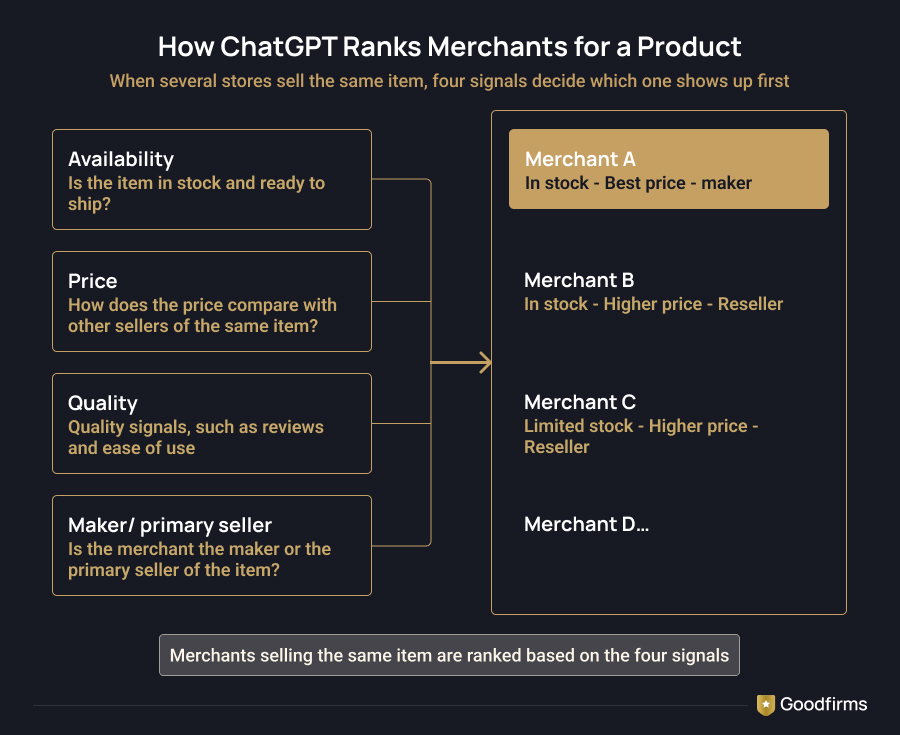
When it comes to picking products, OpenAI is very particular. It weighs structured metadata from merchants and third-party providers and ranks merchants selling an item by availability, price, quality, and whether they're the maker or the primary seller.
ChatGPT's shopping experience now centers on discovery and comparison, not just checkout. In March 2026, OpenAI shifted its focus from Instant Checkout to helping people discover and compare products. The experience now includes richer product details, side-by-side comparisons, visual browsing, and more up-to-date information from merchants. For most merchants, shoppers still purchase on the retailer’s own website or app rather than inside ChatGPT, although OpenAI has since brought in-chat purchasing back for some Shopify brands.
For merchants, visibility now depends on how well ChatGPT can find, read, and trust their products. The components below cover each step. (If you're weighing which discipline matters most, “Should you follow SEO, AEO or GEO?” is worth a look, since ChatGPT visibility draws on all three.)
8 Key Components of an Effective ChatGPT Ecommerce SEO Strategy
Each of these eight needs regular upkeep, not a one-time setup. Together, they're what separates a store ChatGPT can find from one it actually recommends.
1. Let OpenAI's search crawler reach your store
Before you touch a single product page, check whether ChatGPT can see your site at all.
OpenAI runs separate crawlers that reach your store and surface your products in ChatGPT search and shopping results. It has three distinct crawlers, which are controlled independently by robots.txt.
- OAI-SearchBot → used to surface websites in ChatGPT search.
- GPTBot → used for crawling that may contribute to model training.
- ChatGPT-User → used when a ChatGPT user requests information from a particular page.
If you don't want your public site content used for model training, OpenAI provides a mechanism to disallow GPTBot while still allowing OAI-SearchBot for search visibility.
The most common failure is a broad wildcard block, an old AI-blocking rule, or a security plugin catching OpenAI's crawlers — not a missing line in robots.txt. Check your robots.txt file, your CDN's bot rules, and your server logs, not just the obvious settings screen.
Once your crawler access is sorted, check how readable your pages actually are. Adobe's AI Content Visibility Checker found that retail product pages score an average of 66%, meaning roughly a third of what's on them is invisible to language models. Run your own product pages through it before assuming your content is the problem.
|
Crawler |
Used for training |
Affects search/shopping visibility |
|---|---|---|
|
GPTBot |
Yes |
No |
|
OAI-SearchBot |
No |
Yes |
|
ChatGPT-User |
No |
No |
2. Make your pages technically readable for AI
Crawler access answers whether ChatGPT can reach your page. This section answers the question of whether it can actually read what's on it.
AI crawlers execute little to no JavaScript, which means anything rendered client-side, product specs loaded into a React component, prices pulled in after page load, and comparison tables built with JS may be invisible to them, even on a page that's fully allowed in robots.txt. Server-rendered or static HTML doesn't have this problem, since the content is already in the page source before any script runs.
Page speed plays a smaller but related role. A slow-loading page increases the odds that a crawler times out before reaching the content that matters, particularly on category or comparison pages with heavy image loads.
Practical checks: view your page's source (not the rendered DOM) and confirm your key specs, price, and availability are actually present in that raw HTML. If they're missing, that's content an AI system can't see, regardless of how well-written it is.
3. Get your product data in shape
If you sell on Shopify, your catalog integrates automatically with ChatGPT with no extra setup, and Shopify developers can help you get that set up correctly. Other merchants can explore OpenAI's direct product-feed options to provide current catalog information or work with ecommerce development companies to get their platform and feed set up correctly.
When ranking merchants offering the same product, ChatGPT considers availability one of the factors. It is important to maintain real-time inventory updates, as item availability directly influences rankings in AI shopping results.
To make your product data easily understood by ChatGPT, keep your titles and descriptions factual, consistent, and rich in key searchable attributes such as size, material, use case, ingredients, and anything else that applies to your category.
Where that information lives on the page matters too. Keep key specs and attributes in the page's static HTML, not buried behind a JavaScript tab or accordion that a crawler may not render. If a shopper needs to click to see it, assume an AI crawler might miss it as well.
Structured data (schema markup) gives machines a consistent way to read your page. OpenAI hasn't confirmed it as a ranking factor for ChatGPT shopping results, so treat it as a readability aid rather than a guaranteed visibility boost.

Make sure your product page and feed agree on variant, price, availability, and purchase URL. Then track ChatGPT referral visits and purchases separately from answer appearances, since visibility alone doesn't prove conversion.
4. Write content that answers shopping questions
Shoppers on ChatGPT ask longer, more specific questions like "best running shoes for a beginner with wide feet who mostly runs on pavement.” On Google, the search will be "Best running shoes." That’s why your content needs to answer that kind of question directly, not just rank for the short version.
Build pages around real buying scenarios: comparison pages, use-case category pages, and buying guides. Put the direct answer in the first sentence or two, then support it. A simple comparison table for two or three options tends to help more than another paragraph of prose.
A short FAQ block performs a similar function at the product level. Add two or three real questions to product and category pages, each with a direct one- or two-sentence answer underneath. That question-and-answer format tends to match how AI systems extract and quote content, so it's worth the extra structure.
Reviews matter too, but they should be approached as an editor would. Good comparisons should include both the strengths and the limitations, rather than relying on generic “10 best” lists designed mainly to attract traffic. The purpose should be to give readers useful, well-rounded information, not thin, one-sided content.
5. Optimize category and comparison pages for ChatGPT
Product pages sell one item. Category pages are where ChatGPT looks for options, which makes them the more important page type for "best X for Y"- style queries.
Write real intro copy at the top of the category, not a boilerplate paragraph, and use it to name the two or three products worth considering and why. Keep specs and attributes in a scannable format (a table or short list) rather than burying them in paragraph text, since that's what ChatGPT extracts most easily when building a comparison.
A category page built only to funnel traffic to individual SKUs misses this entirely. If a shopper asks ChatGPT for "waterproof hiking boots under $150 for wide feet," it needs a page that already narrows the field, not six separate product pages it has to compare on its own.
6. Build the trust signals ChatGPT weighs
Ranking factors aside, a lot of what gets a product recommended comes down to whether ChatGPT can vouch for it. OpenAI says it can factor in price, reviews, and ease of use when a question calls for it, alongside the metadata already on your feed.
Practically, that means keeping your review volume and quality up, keeping your brand details consistent across your site and any marketplaces where you sell, and earning mentions in reviews or comparisons written by others, not just your own.
If you resell a product that the manufacturer also sells directly, know that you're starting from a structural disadvantage on the "maker or primary seller" factor. Your realistic levers are price, availability, and service, so make sure those are the parts of your listing that are hardest to beat.
7. Track what ChatGPT sends you
You can't improve a ChatGPT ecommerce SEO strategy if you're not measuring it.
ChatGPT automatically tags outbound links with utm_source=chatgpt.com, so you can isolate that traffic in your existing analytics setup rather than guessing at it. It's also worth checking your server logs for OAI-SearchBot activity to see whether you're actually being crawled, not just theoretically allowed.
Beyond analytics, run your own prompt tests. Once a month, ask ChatGPT the kinds of questions your buyers ask, and note whether your brand shows up, who shows up instead, and what those results are drawing from. If you're already using one of the SEO tools & software in 2026 for traditional rank tracking, find out whether it also offers AI-visibility tracking.
Don't put too much weight on a single result, though. Search results can change from one run to another, so it's more useful to look for patterns over time.
8. Show up where ChatGPT is already reading
Get your brand mentioned where AI learns. Reddit threads, forums, and independent comparison sites feed into ChatGPT's answers alongside your own product pages. Component 4 is about earning those mentions; this one is about staying visible once they exist. You can't control what's said there, but you can monitor it, weigh in transparently where appropriate, and ensure independent reviewers and comparison sites actually have access to your product. AI recommends what it's seen recommended elsewhere.
Putting the ChatGPT Ecommerce SEO Strategy into Action
Initially, start by confirming whether ChatGPT can access your site. From there, check that your product information is accurate and up to date. Then, look at the pages bringing in the most traffic and make sure they answer the questions your customers are actually asking. Once that’s covered, keep an eye on reviews and mentions, and track your results to see whether the changes are having an impact.
ChatGPT's shopping experience keeps evolving, so a ChatGPT ecommerce SEO strategy needs regular check-ins on visibility and traffic. Brands that build this in now, before AI shopping becomes mainstream, will stay ahead of the curve.
FAQs- ChatGPT Ecommerce SEO Strategy
Do I need a separate product feed for ChatGPT?
Not always. If you sell through Shopify, your catalog is already integrated with ChatGPT, and no extra setup is required. If you sell through another platform, you can apply to share a direct product feed with OpenAI, which keeps your pricing, availability, and product details up to date in ChatGPT's shopping results. Without a feed or an integrated platform, ChatGPT has to rely on whatever it can read on your public site, which is a weaker, less reliable signal.
Should I block GPTBot on my site?
Blocking GPTBot and appearing in ChatGPT search are two separate decisions, so that you can make them independently. GPTBot is OpenAI's crawler for collecting data used in model training, and you can disallow it in robots.txt if you don't want your site's content used that way. OAI-SearchBot is the crawler that surfaces your pages in ChatGPT's search results, so it needs to remain allowed if you want your products to show up there, even if you've blocked GPTBot entirely.
How do I know if ChatGPT is sending me traffic?
ChatGPT automatically tags outbound links with the parameter utm_source=chatgpt.com, so you can filter for that traffic inside your existing analytics platform rather than estimating it. Also, check your server logs for requests from OAI-SearchBot, since that confirms whether OpenAI's crawler is actually reaching and reading your pages, not just theoretically allowed to do so. If you see crawler activity but no UTM-tagged traffic, your pages may be readable but aren't yet being recommended in ChatGPT's answers.
Does schema markup help my ChatGPT visibility?
Schema markup gives machines a consistent, structured way to read the facts on your page, such as price, availability, and ratings; this improves visibility in AI systems. OpenAI hasn't confirmed structured data as a direct ranking factor in ChatGPT shopping results, though, so it shouldn't be treated as a guaranteed shortcut to being recommended. Keep your schema accurate and exactly match it to what a shopper actually sees on the page, since a mismatch between marked-up data and visible content can erode trust rather than improve visibility.
How can I improve my product's visibility in ChatGPT?
Improving visibility in ChatGPT comes down to eight things: make sure OpenAI's OAI-SearchBot crawler can actually reach your site, keep key specs and pricing in your page's raw HTML rather than behind JavaScript, keep your product data (titles, attributes, and availability) accurate and current, structure category and comparison pages so ChatGPT can pull them into "best X for Y" answers, write content that answers the specific buying questions shoppers ask, build trust signals like consistent brand details and genuine reviews, track the traffic and prompt results you're actually getting, and stay visible in the reviews, forums, and comparison sites that ChatGPT draws on beyond your own product pages.


.jpg)