Key takeaways
- Outsourcing typically runs $20,000–$150,000 for a full build, compared to $75,000–$145,000 for the same scope built in-house.
- In-house pays off in the long term, not upfront — it makes sense when the app is your core product, and you have 12+ months of runway to cover salaries and infrastructure.
- The choice isn't permanent — many founders outsource to build and validate, then move in-house once revenue justifies it.
In-House or Outsourcing:Mobile App Development Cost at a Glance
Deciding between in-house and outsourcing is one of the first big calls you'll make in mobile app development. Both paths can help build your app, but they diverge sharply in cost, speed, and the level of control you retain along the way. Before diving into the details, a quick look at what in-house and outsourced mobile app development typically cost:
|
Model |
Typical Cost |
Time to Start |
|---|---|---|
|
In-house (engineering only) |
$150,000–$300,000+ |
Weeks to months |
|
Outsourced (simple MVP) |
Starting around $15,000 |
Days to weeks |
|
Outsourced (full-featured build) |
$20,000–$150,000 |
Days to weeks |
|
Annual maintenance (either model) |
15–25% of the build cost |
Ongoing |
For context on how far the space has come, it's worth looking at the evolution of mobile app development before diving into today's build-vs-outsource decision.
And the stakes are only getting bigger. The global mobile application market is projected to grow from USD 322.6 billion in 2026 to USD 885.3 billion by 2033, at a CAGR of 15.5% over the period. The wrong development model can put your budget and your position in a market that's about to triple at risk.
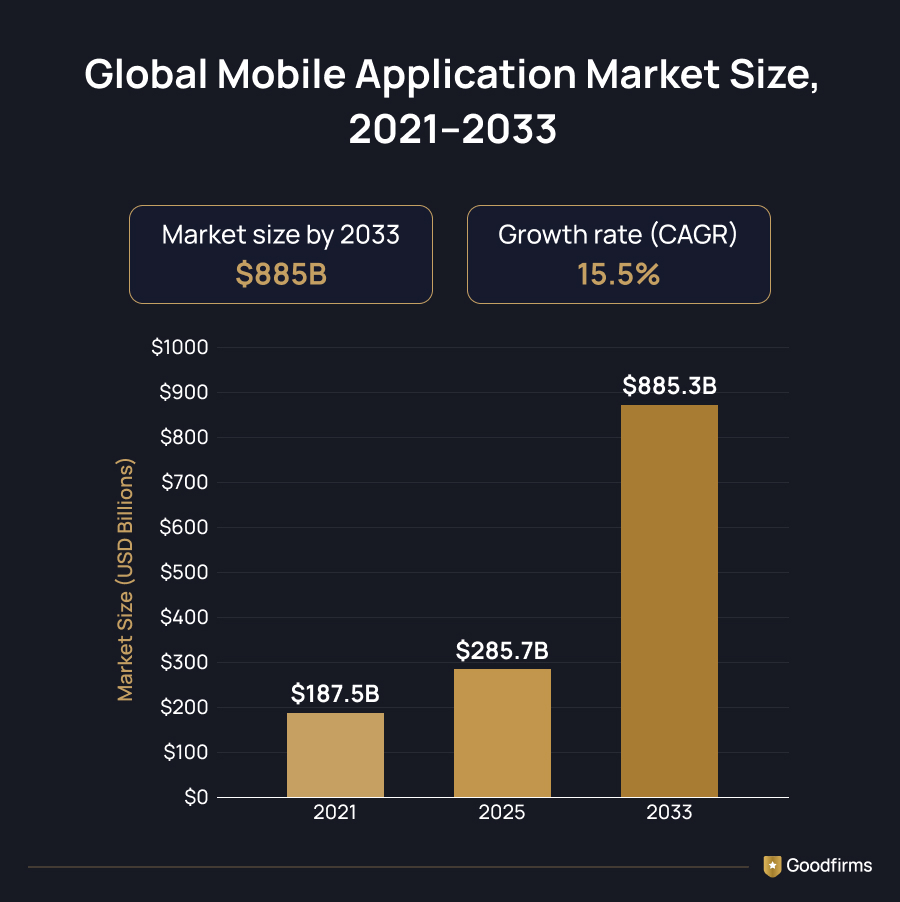
Source: Grand View Research
This blog breaks down the actual numbers behind in-house vs outsourcing mobile app development, so you can figure out which model fits your budget, not just which one sounds better on paper.
Ready to build smarter? Compare vetted mobile app development companies with real client reviews on Goodfirms and find the right partner for your budget and timeline.
Let's start with the option most founders default to first — building the team yourself.
What does In-house Mobile App Development Really Cost?
Hiring an in-house team means building a group of employees who work only on your product. You get to shape the priorities, the culture, and the entire way of working. But that freedom carries a cost most people don't see coming until it's too late.
In the US, an in-house mobile developer's base salary typically ranges from $104,000 to $120,000 per year (averaging $50 to $58 per hour), depending on the state — that's before benefits, payroll taxes, equipment, and other overhead are added. For a detailed state-by-state breakdown, see the app development cost in the US pricing guide.
That's also before you've hired a designer, a QA engineer, or a project manager. For a mid-complexity app — think an MVP with a handful of core features — you're usually looking at 1,500 to 2,500 development hours. At those in-house labor rates, that translates to roughly $75,000 to $145,000 just for engineering time, not counting testing, deployment, or ongoing support.
And the costs don't stop once the app ships. Industry estimates put annual maintenance at 15% to 25% of the original build cost. So a $100,000 app quietly turns into a $115,000 to $125,000 yearly commitment, every year, for as long as the app is live.
|
Cost component |
Typical range |
|---|---|
|
Annual cost per in-house developer (US) |
$104,000–$120,000 |
|
Development hours (mid-complexity app) |
1,500–2,500 hours |
|
Engineering cost (mid-complexity app) |
$75,000–$145,000 |
|
Annual maintenance (% of build cost) |
15%–25% |
What you get in return is real: deep product knowledge that builds up over time, instant collaboration since everyone sits on the same team, and a workforce that's fully dedicated to your roadmap if your app is the core of your business — not a side project — that kind of ownership is hard to replace.
Now flip the model and see what happens when you hand the build to an external team instead.
What does Outsourcing Mobile App Development Actually Cost?
When businesses outsource mobile app development, the cost structure changes significantly. Instead of paying fixed salaries and benefits, you pay for output — a defined scope of work, delivered by a team that isn't on your permanent payroll.
Hourly rates vary a lot by region. Developers in India typically charge $12 to $50 per hour —the full breakdown by experience level and city is available in this app development cost in India guide. Eastern European developers charge $25 to $55 per hour, and North American agencies charge $50 to $150+ per hour, depending on the state and city.
A full-outsourced build — covering the backend, admin dashboards, and basic analytics — usually falls between $20,000 and $150,000, depending on complexity. Simpler MVPs can come in well under that, sometimes starting around $15,000.
Outsourcing Cost Breakdown by Region
|
Region |
Hourly Rate |
Best Suited For |
|---|---|---|
|
India |
$12–$50/hr |
Budget-conscious builds, MVPs |
|
Eastern Europe |
$25–$55/hr |
Mid-complexity builds a balance of cost and communication ease |
|
North America |
$50–$150+/hr |
Premium builds, close time-zone alignment |
Typical Outsourced Project Cost
|
Build Type |
Estimated Cost |
|---|---|
|
Simple MVP |
Starting around $15,000 |
|
Full-featured build (backend, admin dashboard, analytics) |
$20,000–$150,000 |
The bigger-picture numbers back this up: app development outsourcing to cost-effective regions can save businesses 30% to 60% on labor costs alone. That's not a marketing claim — it's the direct result of paying India or Eastern Europe rates instead of US in-house salaries for the same output.
Mobile app outsourcing also converts a fixed cost into a flexible one. You're not carrying a developer's salary during the slow months between projects. You can scale a team up before a launch and scale it back down once things stabilize — something that's genuinely hard to do with in-house staff without disrupting morale or momentum.
The trade-off is that you're relying on a partner you don't manage day to day. Communication, time zones, and how well the outsourcing team understands your product are variables you have to actively manage rather than assume.
If outsourcing looks like the right fit, the next step is finding a provider that offers reliable mobile app development services and has proven experience delivering similar projects— verified IT outsourcing companies with real client reviews take much of the guesswork out of vendor selection.
With both cost structures on the table, it's easier to see how they actually compare head-to-head.
In-house vs Outsourcing for Mobile App Development: A Side-by-Side Look
Sometimes the best way to make a decision is just to see the numbers laid out in front of you. So put the two side by side, and the trade-offs become obvious fast.
|
Factor |
In-House |
Outsourcing |
|---|---|---|
|
Typical annual cost (US) |
$104,000–$120,000 per developer |
N/A — project-based |
|
Typical project cost |
$150,000-$300,000+ (engineering only) |
$20,000-$150,000 (full build) |
|
Hourly rate |
Salaried, not hourly |
$12-$150+/hr depending on region |
|
Time to start |
Weeks to months (hiring) |
Days to weeks |
|
Control over process |
Full |
Shared, contract-dependent |
|
Flexibility to scale |
Low, disruptive |
High |
|
Best suited for |
Core, long-term products |
MVPs, pilots, budget-conscious builds |
|
Ongoing maintenance |
15-25% of the build cost yearly |
Often bundled or quoted separately |
This table captures the core trade-off in the in-house vs outsourcing mobile app development decision: control and continuity on one side, cost flexibility and speed on the other.
The numbers only tell half the story — the right choice also depends on where your business stands right now.
When to Choose In-house vs Outsourcing
Instead of thinking about this in the abstract, it helps to look at where your business actually stands right now and match it to the model that best fits.
|
Your situation |
Recommended model |
|---|---|
|
App is your core product, not a supporting feature |
In-house |
|
Need constant, long-term iteration, not a single build-and-launch cycle |
In-house |
|
Deep institutional knowledge matters, and you want the same people maintaining it for years |
In-house |
|
You have 12+ months of runway to cover salaries before meaningful revenue |
In-house |
|
Building an MVP or pilot to validate an idea |
Outsourcing |
|
Internal team lacks specific skills, like mobile-specific expertise |
Outsourcing |
|
Budget is fixed and needs predictability |
Outsourcing |
|
Speed to market matters more than long-term ownership right now |
Outsourcing |
For most early-stage businesses and budget-conscious teams, mobile app outsourcing tends to win because it provides faster access to development talent without the long-term cost of building an internal team. If you're at that stage, browsing MVP development companies with verified reviews is a good starting point for finding the right outsourcing partner. In-house costs more when the app is the business itself and there's a runway to support it.
If you are still not sure which model to choose, then quickly go through this framework instead.
A Quick Decision Framework
If you're still torn, ask yourself three questions:
|
Question |
Leans in-house |
Leans outsourcing |
|---|---|---|
|
Is the app central to your business, or a supporting tool? |
Central to the business |
A supporting tool |
|
Do you have 12+ months of runway to cover salaries before revenue kicks in? |
Yes |
No |
|
Do you need this live in the next few months, or are you building for the next several years? |
Building for the long term |
Need it live soon |
And if you're still not fully sure, know that the decision doesn't have to be permanent — more on that next.
The Middle Path: How the Hybrid Model Works
There's a middle path that often gets left out of the in-house vs outsourcing conversation: you don't have to pick one and stick with it forever.
This isn't just a startup workaround, either — Deloitte reports that 70% of organizations have brought previously outsourced work back in-house over the last five years, largely to strengthen internal capabilities, improve service quality, and reduce vendor markups.
Many companies start by choosing app development outsourcing for the initial build and then transition to an internal team once the product gains traction. If you're at the scoping stage, it's worth knowing what to consider when designing the MVP for your app before you brief an outsourcing partner.
This hybrid approach works well because it matches spending to risk. In the early days, when it's still unclear whether the product will even take off, you're not stuck paying salaries and overhead for a team that might not be needed. Once the business case proves itself, though, the fixed cost of building an in-house team makes a lot more sense.
Some companies take a hybrid route too — keeping sensitive, core work like backend architecture or proprietary algorithms close to home, while handing off more standardized pieces like UI design or QA testing to outside teams. For this kind of task-specific outsourcing, software development companies with a broader technical range can be a better fit than a mobile-only shop.
If you're not ready to commit fully to either path, starting with outsourcing and planning a future transition to in-house is often the lowest-risk way forward.
The smartest companies aren't choosing one model over the other—they're running a hybrid setup: a small, senior in-house team that owns architecture and product direction, paired with an outsourced team that handles execution and specialist work. This gives you institutional knowledge and speed without the full cost burden of either extreme.
Whichever path you lean toward, though, it helps to go in with eyes open about what could go wrong.
Risks and Challenges to Watch for with Each Model
Cost isn't the only factor that can derail a mobile app project. Each model carries its own operational risks that need to be planned for.
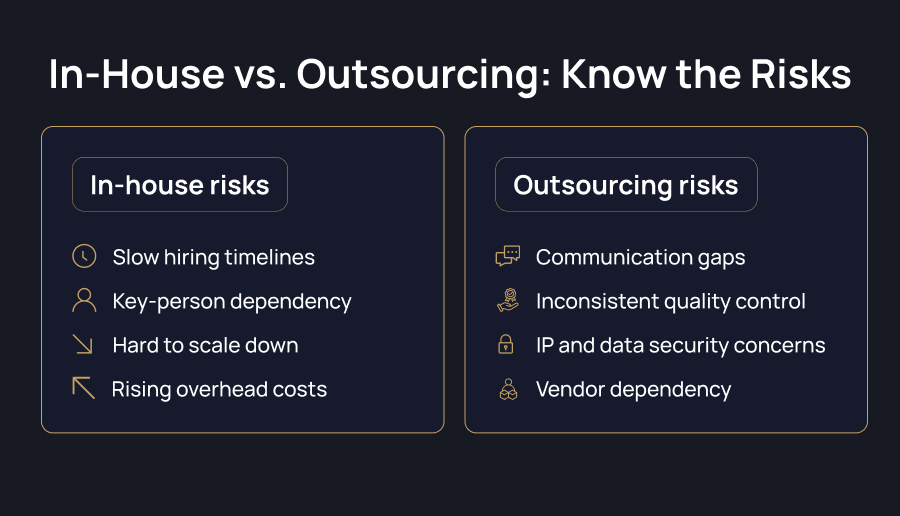
In-house Challenges
- Hiring takes time: Sourcing and onboarding the right mobile developers often takes weeks or even months — and that clock is ticking before you've written a single line of code.
- Too much dependency on one or two people: If your product knowledge resides mainly in the heads of one or two developers, losing either of them mid-project can bring the project to a halt.
- Scaling down is messy: Once a team's in place, cutting headcount during quieter stretches tends to hurt morale and disrupt momentum.
- Rising overhead costs: Salaries are just the starting point — benefits, equipment, software licenses, and office space add up fast, and those costs don't disappear during slower project phases.
Outsourcing Challenges
- Communication friction: Different time zones and language barriers can lengthen feedback loops and create confusion about what's actually needed.
- Quality control gets tricky: With no one watching day-to-day, some outside teams may skip corners on testing or documentation — unless your contract nails down exactly what's expected.
- IP and data exposure: Giving an external team access to your proprietary code or business logic means you can't afford to skip solid contracts and NDAs from the outset.
- Vendor dependency: If the outsourcing partner is unresponsive or shuts down, you may struggle to quickly find another team that understands your codebase.
Don't let either list put you off — these are just the flip side of what makes each model work in the first place. Get ahead of them early with clear contracts, solid documentation, and timelines that reflect reality, and most of these surprises never actually show up.
Some of these risks show up as costs too — ones that rarely make it into the first quote.
The Hidden Costs Nobody Mentions Upfront
Whichever model you choose, a few costs tend to get left out of the initial comparison:
- Management overhead: An offshore developer at $25/hour can effectively cost $35-$40/hour once you factor in coordination, ramp-up time, and rework.
- Hidden fees in outsourcing contracts: Surveys of outsourcing buyers consistently list unexpected fees as the top surprise in offshore agreements — so get scope and billing terms in writing before signing anything.
- Maintenance: In-house or outsourced, budgeting 15-25% of the build cost annually for updates and fixes isn't optional — it's the real cost of keeping an app alive.
- Unclear scope: Two quotes for "the same app" rarely cover an identical scope. Always compare feature lists line by line, not just the final number.
Factor in those extra costs, and the real picture looks like this.
Concluding Remarks
Neither approach wins outright — whether in-house or outsourced development makes more sense for you depends on your budget, your timeline, and how central the app is to your business. If you need to move fast on a limited budget, outsourcing generally offers more flexibility with less upfront risk, especially at the lower end of the cost range.
If the app is your business and you're playing a long game, in-house ownership may be worth the ongoing commitment of a fixed annual salary, even though the two models now land closer together in raw project cost than they used to. Either way, go in with real numbers — not just the headline hourly rate — and you'll make a decision your budget can actually live with.
Still have a few specific questions? Here are quick answers to the ones that come up most often.
FAQs:In-House vs Outsourcing-Which Model Fits Your Budget?
Is outsourcing cheaper than in-house app development?
In most cases, yes. Outsourcing tends to reduce labor costs by 30% to 60% compared to building in-house, mainly because you're paying regional hourly rates rather than shouldering full US salaries, benefits, and overhead.
How much does it cost to build a budget-friendly mobile app?
An outsourced MVP can start at $15,000 to $20,000, while a more full-featured version usually falls between $20,000 and $150,000. Building the same scope in-house typically requires $75,000 to $145,000 in engineering time before benefits, payroll taxes, and other overhead are added.
Is in-house development ever the more affordable option?
Sometimes — but usually only if you're looking years down the road. If the app needs ongoing development for the long haul, the fixed cost of an in-house team can eventually offset the cost of outsourcing for updates.
Can I switch from outsourcing to in-house later?
Yes, and plenty of companies do exactly that. Outsourcing the initial build keeps costs manageable early on and gives you room to validate the product before committing further. Once it gains traction and starts bringing in steady revenue, shifting to an in-house team becomes a natural next step.
Does outsourcing mean giving up control over the product?
Not really. Requirements, priorities, and overall direction remain in your hands — what changes is who manages the day-to-day execution. Clear contracts, a well-defined scope, and regular check-ins go a long way toward keeping the control founders worry about losing, even though it won't feel quite as direct as overseeing an in-house team in person.