Key takeaways
- An offshore development center in India is no longer just a cost-saving model. It is a strategic way for US companies to build sustained software delivery capacity when local hiring is slow, expensive, and difficult to scale.
- Unlike project outsourcing or staff augmentation, a dedicated ODC provides long-term context, ownership, and continuity, helping teams avoid the repeated productivity losses that come with short-term vendor models.
- India remains a strong offshore development center destination because of its mature engineering ecosystem, experienced delivery leadership, and depth of enterprise-grade software development talent.
- A modern ODC can support much more than basic coding, including application development, modernization, QA, DevOps, cloud engineering, integrations, and ongoing application maintenance.
The meeting usually happens on a Tuesday, sometime between the third delayed product release and the realization that the engineering budget is quietly evaporating. In a glass-walled conference room in Austin, Chicago, or Denver, a Chief Technology Officer is staring at a hiring pipeline that looks less like a funnel and more like a concrete wall, wondering whether the answer lies with in-house recruiters or with their partner software development company instead.
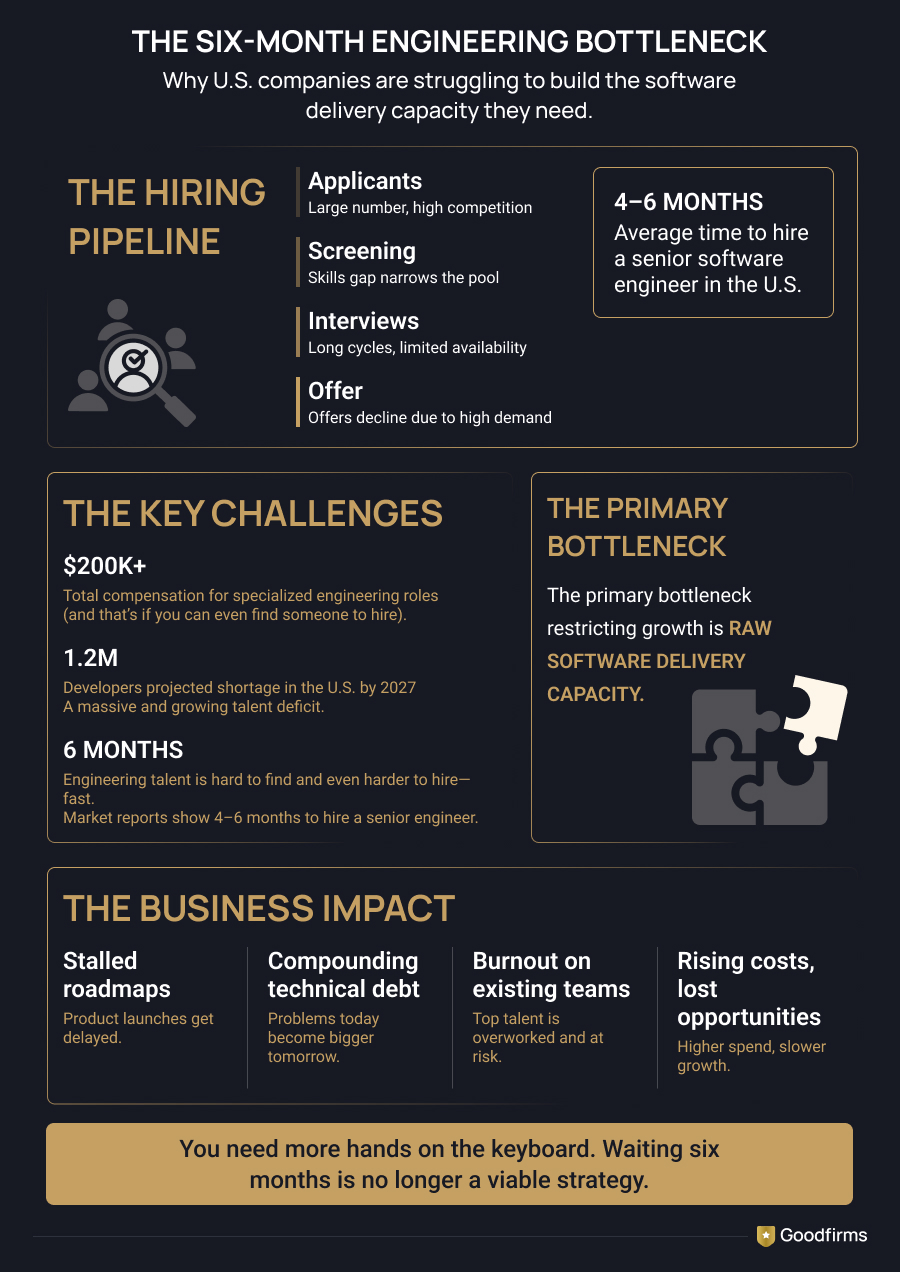
They are trying to hire three senior backend developers to clear a backlog that is starting to threaten the core business. According to the US Bureau of Labor Statistics, the median pay for a software developer sits comfortably above $133,000. But anyone who has actually sat in on vendor evaluations or technical interviews in the current market knows the reality is far more expensive. Total compensation for specialized roles easily pushes past $200,000. And that is assuming you can even find someone to take your money.
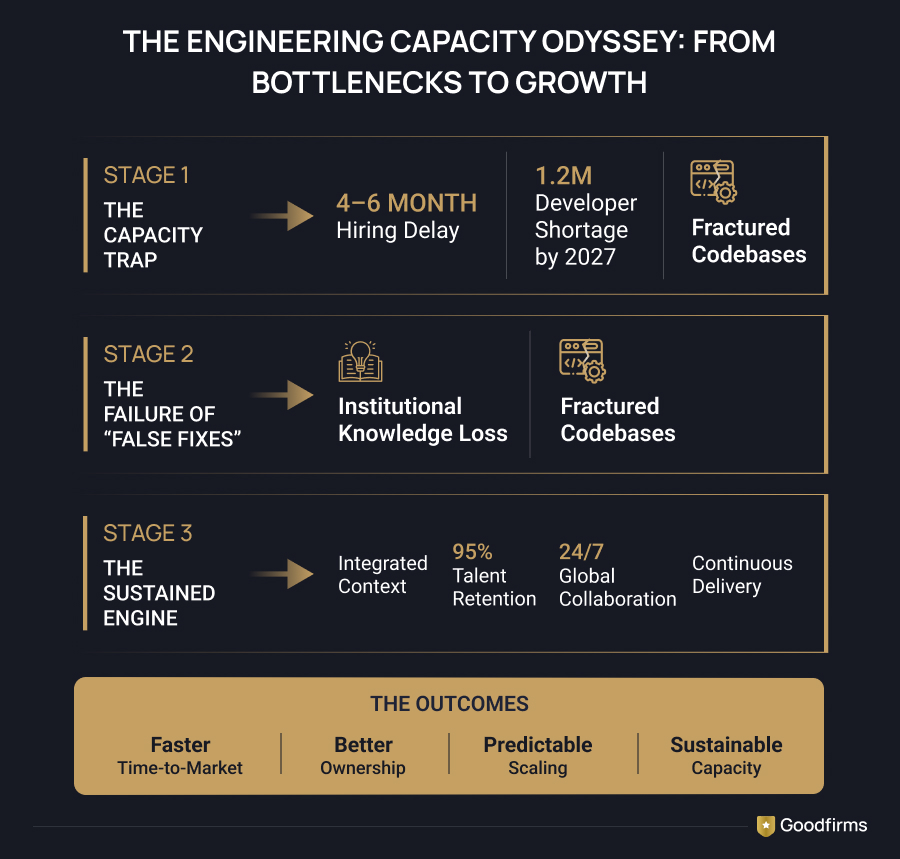
The numbers explain the quiet panic setting across US boardrooms. The US is marching toward a massive talent deficit, with industry data projecting a shortage of 1.2 million developers by 2027. More punishing for a growing company is the timeline. Market reports indicate that the average time to hire a senior software engineer in the US currently ranges from 4 to 6 months.
That is half a year of stalled roadmaps, compounding technical debt, and existing local teams burning out as they try to cover the gap. At this exact point, the leadership team is forced to admit a structural truth. The primary bottleneck restricting the company's growth is no longer market demand or creative vision. The bottleneck is raw software delivery capacity. You need more hands on the keyboard, and waiting half a year to pay premium local salaries for a single developer is simply no longer a viable corporate strategy.
Explore Top IT Services Companies on Goodfirms. Verified reviews. Real projects. No guesswork.
This is the exact moment when the boardroom conversation pivots toward establishing an offshore development center in India.
But here is where the typical corporate narrative often derails. For years, the software industry treated offshore expansion entirely as a labor arbitrage play. It was a spreadsheet exercise in which executives patted themselves on the back for securing lower hourly rates. That mindset is incredibly dangerous today. If you approach this expansion simply as a hunt for cheap coding, you will end up with brittle architecture, communication breakdowns, and a product that requires constant rescuing by your already exhausted local engineers.
However, an offshore development center can shift this paradigm, offering not just cost savings but helping build sustained, compounding software delivery capacity.
Understanding the Mechanics
To get this right, we have to strip away the antiquated definitions of outsourcing. When we use the term offshore development center, we are not talking about tossing a list of unrefined requirements over a wall and hoping a finished product comes back six months later.
We are talking about a highly integrated workspace populated by an offshore dedicated development team that works exclusively for your organization. They operate on your specific tech stack, align with your corporate culture, and march toward your precise business objectives. The center is provisioned with your security protocols, connected to your secure networks, and managed through your preferred agile cadences. To the outside observer, it should be entirely indistinguishable from a branch office you might open in a neighboring state. It just happens to be located in a different time zone.
The Reality of Modern Expansion
Companies are no longer going offshore simply to save money. They are building a second brain. They are establishing dedicated engineering hubs that own product roadmaps, drive architectural decisions, and clear the backlog before it strangles the business.
The Shift in Buyer Intent
The US technology landscape has shifted dramatically over the last few years. The pressure to ship faster has never been higher, yet the local talent market remains stubbornly volatile. Companies are realizing that attempting to build every single piece of their technology stack within a thirty-mile radius of their headquarters is a fundamentally unscalable strategy.
Furthermore, the nature of software development has evolved past the point where a handful of generalist developers can build a modern enterprise platform. Modern applications require deep, specialized expertise in cloud architecture, data engineering, artificial intelligence integration, and automated continuous deployment pipelines. Finding all of those specialized skill sets in a single local market is often statistically impossible within a reasonable timeframe.
This friction forces US decision makers to look outward. They are not looking for traditional vendors to take over their IT department and run it in a black box. Instead, they are looking for a sophisticated offshore IT services company that allows them to seamlessly bolt on mature engineering pods to their existing infrastructure.
Why India Remains the Definitive Anchor
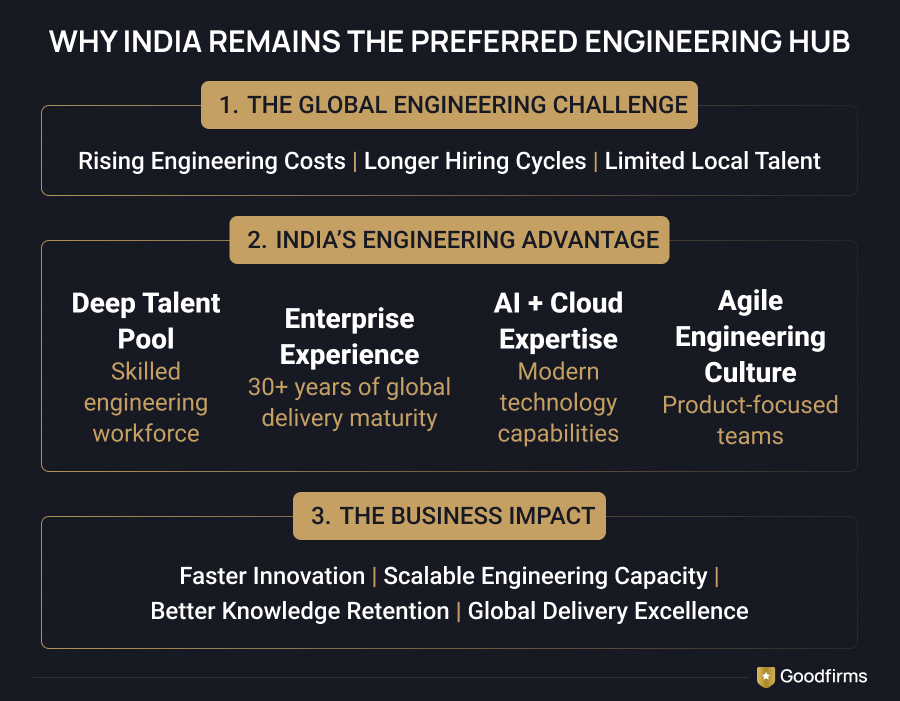
It is easy to casually assume that the massive global remote work experiment has flattened the earth entirely. You might think any country with decent internet is a viable destination for complex software engineering. But when you are looking to build a permanent offshore development center in India, you are buying into an ecosystem that simply cannot be replicated by handing out laptops in a new time zone.
India offers a profound structural advantage that goes far beyond the initial cost calculus. The primary advantage is the market's sheer maturity and density. India has spent over three decades serving as the primary engine room for Fortune 500 technology companies. This history means the talent pool is not just massive; it's also diverse. It is deeply experienced in the exact type of enterprise-grade delivery that US mid-market companies require.
When you build a team in this environment, you are not just hiring individual contributors who know how to configure a database. You are tapping into a highly evolved management layer. India is full of seasoned engineering managers, technical leads, and scrum masters who intimately understand the messy nuances of US product development. They understand agile methodologies. They know how to push back on poorly defined product requirements. They know how to manage complex cloud deployments. This middle management layer is the glue that holds a remote engineering operation together, and it is largely absent in newer offshore destinations.
The Taxonomy of Global Talent
A critical mistake many technology leaders make during the vendor evaluation phase is confusing the different flavors of global talent models. If you do not intimately understand the distinction between project outsourcing, staff augmentation, and an offshore development center, you are practically guaranteeing operational friction down the line.
|
Engagement Model |
How It Works |
The Reality Check |
|
Project Outsourcing |
Transactional. Fixed scope, budget, and timeline. |
Flawed for core IP. The team leaves when the project ends, taking all institutional context with them. |
|
Staff Augmentation |
Tactical. Renting a developer to fill an immediate seat. |
A reactive patch for sudden resignations. It does not build a proactive organizational scale. |
|
Dedicated ODC |
Strategic. A permanent, fully integrated delivery pod. |
Accumulates context over time. Developers act as internal employees and actively own the product roadmap. |
Software is never truly finished. If you outsource your core intellectual property on a strict project basis, you lose all the compounding context. The team that built the software moves on to another client, leaving your internal team to maintain code written by strangers. An offshore development center is a strategic investment in permanent capacity.
The Power of the Pod
The hidden tax in software engineering is context switching and onboarding. Every time you bring a new developer into a complex codebase, you burn weeks of productivity just getting them up to speed on the environment and business logic.
For example, when you leverage an offshore dedicated web development company, you are actively combating this friction. The true, measurable value of a dedicated team lies in the accumulation of context. A developer who has been working on your specific application for two years is infinitely more valuable than a brilliant new hire who just started today.
Execution in Action:Scaling Niche Expertise Without the Overhead
The true test of an offshore setup is handling highly complex, regulated workloads. When a fast-growing North American reinsurance brokerage needed to rapidly scale its catastrophe risk modeling capabilities, a function requiring deep probabilistic assessment and zero margin for error, traditional hiring was too slow. Instead of standard outsourcing, they partnered with Trigent to build a purpose-built offshore delivery center in Bangalore. Within just 12 weeks, Trigent stood up a secure, domain-ready offshore pod of specialized catastrophe analysts, equipped with enterprise-grade infrastructure and governed by a dedicated project manager. The client expanded its critical analytics capacity instantly, with zero infrastructure lift and complete budget predictability.
Because they are dedicated solely to you, these engineers start anticipating problems before they hit the production environment. They stop asking for permission to fix technical debt and just start fixing it. They feel a deep sense of ownership over the product. This level of ownership is nearly impossible to achieve in a transactional outsourcing model, but it is the natural byproduct of a well-run offshore development center.
Expanding the Perimeter: What Services an ODC Actually Supports
A modern offshore development center is not limited to basic coding tasks or low-level maintenance. As the operational model has matured, the scope of work has expanded to cover the entire software development lifecycle. Companies are now pushing highly complex, mission-critical work to their offshore teams with complete confidence.
At the core of the operation are comprehensive application development outsourcing services. This encompasses end-to-end product engineering. It means taking a raw idea from the whiteboard through architecture, active development, rigorous testing, and final deployment. Your offshore team can handle the heavy lifting of building new microservices, transitioning legacy monolithic architectures to modern cloud environments, and building complex integrations with third-party enterprise systems.
Beyond pure feature development, an ODC is the ideal vehicle for establishing a robust Quality Assurance and DevOps culture. By shifting these critical functions to an offshore software development company in India, you can build a relentless round-the-clock testing pipeline. Your US team commits code at the end of their day. The offshore team tests, debugs, and prepares the deployment overnight. When the US team wakes up, the pipeline is green and ready for the next iteration.
Furthermore, an ODC can absorb the grinding reality of application maintenance and support. Legacy systems require constant care, but assigning your most expensive local engineers to patch old software is a guaranteed way to destroy morale. By migrating legacy support to your offshore dedicated development team, you free up your core US talent to focus entirely on innovation.
The Elastic Engineering Organization
Predicting your exact engineering headcount needs for the next 24 months is a fool's errand. Markets shift, venture funding dries up, and product strategies pivot abruptly. You need a fundamental elasticity in your workforce that traditional local hiring simply cannot provide.
This is where offshore team scaling services become an incredibly powerful lever for a technology leader. Instead of committing to permanent overhead in a high-cost geographic market, you can use your offshore partner to dial your engineering capacity up or down based on actual, immediate business needs. If you secure a massive new enterprise client and need to spin up a custom integration pod immediately, a mature offshore software development company can assemble a pre-vetted, domain-specific team in a matter of weeks.
Because your partner handles talent acquisition, compliance, and physical infrastructure, your internal management team is shielded from the administrative burden of scaling. You get the raw engineering throughput without the bloated HR footprint.
The Autopsy of a Failed ODC
Despite the model's proven viability, companies still manage to sabotage their own offshore initiatives with surprising regularity. When you perform an autopsy on a failed offshore setup, the root cause almost always traces back to a fundamental lack of trust and a flawed management philosophy.
The most common, destructive mistake is treating the offshore development center like a second-class citizen. If you withhold critical architectural documentation, exclude offshore leads from sprint planning sessions, and only assign them the most tedious bug fixes, you will create a toxic culture. Your offshore app developers will quickly realize they are viewed as disposable labor, and they will perform accordingly. To extract maximum value from this model, you must mandate aggressive transparency.
Another critical error is severely underinvesting in middle management. For example, when US companies often assume they can manage a thirty-person mobile app development company in India directly from San Francisco without any local leadership on the ground. This is a recipe for operational chaos. A successful offshore dedicated development team requires strong local technical leads who can translate the high-level US vision into daily actionable tasks.
Finally, companies fail when they obsess entirely over the hourly rate. If you choose an offshore software development agency solely because they are the absolute cheapest option on paper, you will inevitably pay tenfold in poor code quality and missed deadlines.
Evaluating Partners: How to Choose Wisely
Selecting the right partner to build and manage your offshore development center in India is arguably the most consequential decision in this entire process. You are entering into a long-term operational marriage. You need a partner that possesses both deep engineering heritage and a sophisticated understanding of mid-market business agility.
When evaluating software development companies, you must look well beyond their marketing collateral and dig deeply into their operational frameworks. Do they have a proven track record of standing up mature delivery pods for companies of your size? You want a partner that uses advanced, structured recruiting to find domain-specific experts, not just generic coders who happen to be available.
Proof of Governance:Building a Global SaaS Hub
When a global leader in IT management and security solutions needed to scale its SaaS and Remote Monitoring & Management platforms, it decided to partner with a software development company in Bengaluru. They required massive scale without compromising their engineering culture or slowing down their global operations. Partnering with Trigent, they utilized a Build-Operate-Transfer model backed by agile delivery pods. Trigent recruited a specialized team of over 100 engineers and operations staff, 50% faster than traditional timelines. The structural alignment enabled continuous 24/7 global collaboration, resulting in a 3x acceleration of product releases and a 40% reduction in operational costs. By integrating local leadership and clear career pathways, the center achieved a 95% employee retention rate and a 4.7/5 engagement score. That is the exact difference between renting a vendor and building an operational partner.
A highly credible offshore software development company will offer flexible engagement models. They should offer variations of Build-Operate-Transfer frameworks, allowing you to start with a managed pilot pod and scale up to a fully transferred center as your strategic needs evolve. They must also bring mature, verifiable governance to the table, including ISO certifications and strict data privacy compliance.
Partners like Trigent have built their reputation precisely on this intersection of enterprise-grade engineering and mid-market flexibility. An experienced partner understands that setting up an ODC goes far beyond leasing real estate or finding generic resumes; it is about establishing a high-performance engineering culture that seamlessly mirrors the client’s own exacting standards. For Trigent, delivering on this standard is backed by 30 years of engineering heritage and an 80% shortlist match rate in talent acquisition, ensuring that the team you build is culturally aligned and domain-ready from day one.
Inside the Engine Room
Once the partner is carefully selected and the doors are open, success depends entirely on the operating model. A high-performing offshore development center runs on rhythm, absolute visibility, and relentless integration.
It always starts with integrated agile pods. Your offshore team should be organized into self-sufficient, cross-functional units containing developers, QA engineers, and a dedicated scrum master. These pods should mirror the exact structure of your internal teams.
Visibility is entirely non-negotiable. A mature ODC relies on real-time productivity metrics and executive governance dashboards. This is not about micromanaging individual keystrokes. It is about intelligently tracking sprint velocity and overall delivery health. If a specific pod is falling behind due to complex technical debt, the data should flag it early enough for US leadership to intervene.
Knowledge transfer must be systemic, not episodic. The best offshore setups utilize strict cross-pod knowledge-sharing protocols, ensuring that if one engineer solves a complex API integration problem, that exact solution is heavily documented and socialized across the entire center.
Securing the Future
The undeniable reality of modern software development is that the scope of work never shrinks. The urgent feature requests from the sales team will continue to pile up. Technical debt will quietly accumulate in the background, waiting to bring down a critical system. If you wait until your software development company in the U.S. is entirely overwhelmed before you start thinking about offshore team scaling services, you have already waited too long.
Building an offshore development center in India is ultimately about taking proactive control of your delivery pipeline. It is a clear acknowledgment that your business requires a scalable, resilient engine for continuous innovation that operates outside the strict financial and temporal constraints of your local hiring market.
By partnering with the right offshore software development company and establishing a dedicated, highly integrated team, you stop playing defense against your product backlog. You fundamentally transform your engineering organization from a constant bottleneck into a strategic enabler.