Key takeaways
- B2B buyers now watch product videos long before they ever talk to sales.
- Video marketing agencies handle strategy, production, and distribution together, not just filming.
- SaaS companies need skilled partners for demos and onboarding videos, not just for brand films.
- AI tools reduce costs and shorten turnaround times, but most agencies still use human editors for customer-facing work.
- Video costs range from $500 for a social clip to $15,000 for a full demo shoot.
- Pick a partner based on industry fit, past work, pricing model, and how well they report results.
Have you ever watched a product demo before booking a B2B sales call? Chances are, you have.
According to Wyzowl's video marketing research, roughly 70% of B2B buyers watch videos at some point during their purchase decision.
A product demo, a quick LinkedIn video from a company executive, or a customer case study can give buyers a better idea of what a product does before they ever speak to sales.
But creating these videos takes more than pointing a camera at a product. Marketing teams need the right strategy, production skills, messaging, and distribution plan. That’s where B2B video marketing agencies come in.
Here’s what these agencies actually do, where video fits into the B2B marketing funnel, and how to choose one that fits your team.
Ready to find a partner that fits your budget and goals? Explore video marketing agencies and compare portfolios, pricing, and client reviews before you reach out.
What Are B2B Video Marketing Agencies
A B2B video marketing agency is one that plans, produces, and distributes video content aimed at business buyers instead of everyday consumers. Most of them sit somewhere between a marketing team and a production studio, so you get creative talent alongside people who actually understand demand generation, sales funnels, and account-based marketing.
General production houses will make a video for anyone. B2B agencies work differently. B2B agencies understand how your business works. They know your sales cycle is longer and more people are involved in buying decisions. They also know your video needs to bring business results, not just views.
Why B2B Companies Need Video Marketing in 2026
Video isn't optional for B2B companies anymore. Video has moved from a nice extra to something buyers expect. A few shifts explain why:
- Buyers research before they talk to sales. Product demos and customer stories let prospects evaluate you long before a first call.
- LinkedIn rewards video. Native clips consistently outperform static posts and plain text links in the feed.
- Remote selling is the norm now. Recorded demos and personalized video messages fill in for meetings that used to happen in person.
- AI has brought costs down. Teams that once skipped video over budget can test formats faster, and buyer expectations have risen right along with it.
- Complex products need showing, not just telling. A two-minute video often explains a SaaS platform better than a page of copy ever could.
Most top video marketing agencies have adjusted to this shift already, blending AI speed with human strategy so output keeps pace with what buyers now expect.
Core Services Offered by B2B Video Marketing Agencies
Most agencies in this space offer some mix of the following, though the exact package changes with size and specialization.
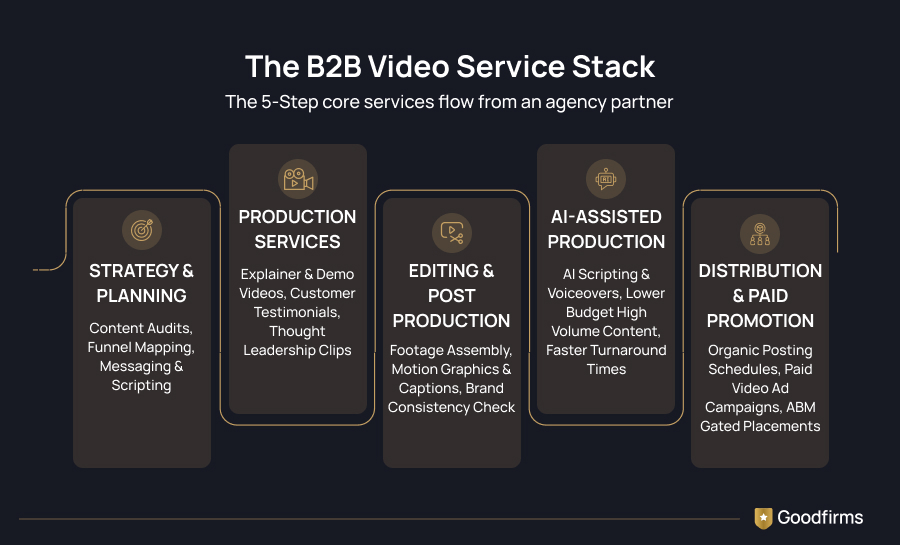
Video Strategy and Planning
- Content audits. An agency looks at what you already have, spots the gaps in your funnel, and flags which formats or topics are missing. This usually happens before any filming gets scheduled.
- Funnel mapping. Every video gets assigned a stage, awareness, consideration, or decision, so nothing gets made just because it seemed like a good idea. This keeps production tied to actual buyer questions.
- Messaging and scripting support. Someone works out the core message and script before anyone picks up a camera. Skipping this step is usually why finished videos feel generic or off-brand.
Production Services
- Explainer videos. This is most useful when a product takes longer to understand than it does to watch. For B2B teams, the goal is usually to remove the first layer of confusion before a prospect reaches sales.
- Product demo videos. These show a platform in action, walking through real features instead of just describing them. They work well on pricing pages and in sales follow-up emails.
- Customer testimonial videos. Real customers talk about results in their own words, which builds trust faster than a written quote. Agencies usually handle scheduling, interview questions, and editing.
- Case study videos. A written case study gets turned into a short, visual story with data points and quotes woven in. These tend to hold attention longer than a PDF ever does.
- Thought leadership and interview videos. Founders, executives, or subject matter experts talk through industry topics on camera. These build credibility and give sales and marketing a steady content source.
Editing and Post-Production
- Footage assembly. Raw clips get cut into a clean final video with proper pacing, so nothing feels rushed or drags on longer than it should.
- Motion graphics and captions. Text overlays, lower thirds, and captions get added so the video still works with the sound off, which matters a lot on LinkedIn and other social feeds.
- Brand consistency. Colors, fonts, and intro or outro templates follow your existing brand guidelines, so the finished video looks like it came from your company, not a random studio.
- Repurposing. One long video gets cut into several shorter clips for social, email, and ads, so a single shoot stretches across multiple channels instead of getting used once.
AI-Assisted Video Production
- Scripting support. AI tools draft a first-pass script based on your messaging, which a human writer then tightens and edits.
- Voiceovers and avatars. Some agencies use AI voices or digital presenters for lower-budget or high-volume content, especially explainer or how-to videos.
- Faster turnaround. AI-assisted editing and captioning can cut production time significantly for social clips and other short-form content.
- Human review stays in the loop. Most agencies still have an editor check anything customer-facing, since AI-only output tends to look generic without a pass from a person.
Weighing AI against professional production usually comes down to budget and how customer-facing the video is. If you're still deciding, video production vs AI videos breaks down the tradeoffs in more detail.
Distribution and Paid Promotion
- Organic posting schedules. Agencies plan and post content across LinkedIn, YouTube, and other B2B-relevant platforms on a consistent cadence, instead of publishing whenever something is ready.
- Paid video ad campaigns. Video gets tied to account-based marketing lists so the right accounts see the right message, rather than running one generic ad to everyone.
- Embedded placements. Video gets built into email sequences, landing pages, and sales decks, so it shows up wherever a prospect is already looking, not just on social.
How Agencies Use Video for B2B Marketing
Beyond the service list, here's how agencies use video marketing for clients across each stage of the funnel, from first click to closed deal.
1. Lead Generation and Demand Gen
Agencies build short-form and mid-length videos meant to catch attention on paid and organic channels, then push viewers toward gated content, demo requests, or newsletter signups.
2. Sales Enablement
Sales teams keep asking for video assets they can send straight to prospects, things like personalized intro clips, recorded product walkthroughs, and short case study videos that slot into an email or a LinkedIn message.
3. Account-Based Marketing (ABM)
For high-value target accounts, some agencies build custom videos that reference a specific company's challenges or industry, which tends to land faster than generic outreach.
4. SaaS Onboarding and Product Education
For SaaS companies, video keeps working after the sale closes. Agencies build onboarding walkthroughs, feature announcement clips, and help-center videos that cut down support tickets and help with retention.
5. Event and Webinar Repurposing
Instead of letting a 45-minute webinar sit unused, agencies pull out highlight clips, quotes, and short segments that get reused across social and email for weeks after the event wraps.
6. LinkedIn and B2B Social Content
Since LinkedIn's algorithm favors native video, agencies often keep a steady drip of short clips going, executive commentary, quick product tips, whatever keeps a company visible in feeds without leaning only on paid ads.
Types of B2B Video Marketing Agencies
Picking from the many video marketing agencies out there gets easier once you know what actually separates one type from another:
- Full-service B2B agencies that handle strategy, production, and distribution under one contract are a good fit if you do not want to juggle multiple vendors.
- SaaS-focused video agencies that specialize in product demos, onboarding content, and technical explainer videos for software companies.
- Boutique production studios that mostly handle filming and editing are better suited if your strategy is already sorted in-house.
- AI-first video agencies that lean heavily on AI tools for speed and lower costs, often useful for high-volume, lower-budget content like social clips.
If you are evaluating top b2b saas video marketing agencies, check whether they have actually built onboarding content and feature walkthroughs, not just demo videos for the sales team. And when comparing the best agencies for b2b video marketing agencies more broadly, look past the demo reel to their process, references, and how they price ongoing work.
How to Choose the Right B2B Video Marketing Agency
Finding the best video marketing agencies for your team is less about the most polished portfolio and more about matching an agency's strengths to your actual goals.
1. Check Industry and Product Fit
- Has the agency worked with companies in a similar industry or with a similar sales cycle
- Do they understand technical products, or only consumer-facing brands
- Can they speak to B2B goals like pipeline and sales enablement, not just views and likes
2. Review Past Work and Case Studies
- Ask for examples close to what you actually need, whether that is demos, testimonials, or social clips
- Look for measurable outcomes tied to past projects, not just the finished videos
- Request references from past B2B clients when you can
3. Understand the Production Process
- Who handles scripting, filming, and editing, and is any of it outsourced
- What is the typical turnaround from kickoff to final delivery
- How many rounds of revisions are included before extra costs kick in
4. Ask About Their Tools and Tech Stack
- Which parts of production are AI-driven versus handled by a human editor
- What editing, hosting, and analytics tools do they rely on day to day
- Whether they build a custom workflow per client or run every project through the same toolkit
Most agencies blend traditional filming with AI-assisted tools for scripting, editing, or generating full videos on lower-stakes content. Push for specifics on which parts are AI-driven versus handled by a human editor, then weigh that setup against the best AI video generators you could run in-house instead.
5. Compare Pricing Models
- Project-based pricing for one-off videos
- Retainer models for ongoing content production
- Hybrid pricing that mixes a base retainer with per-project add-ons
6. Look at Reporting and Analytics
- Does the agency track engagement, watch time, and conversions, or only hand over finished files
- Can they tie video performance back to pipeline or revenue
- How often do they share reports and adjust strategy based on what the data shows
Reporting should tie back to marketing outcomes, not just view counts. If an agency can't connect a video to pipeline movement, they're guessing as much as you are.
Where the Work Actually Happens: Editing, Hosting, and Beyond
Most agencies don't run production through a single platform. They piece together a setup across a few categories, editing, hosting, analytics, and AI production, and lean on whichever mix fits their workflow. Here's a look at the top video marketing platforms for agencies, grouped by what each piece actually handles. Many teams also lean on dedicated video-making software to speed up editing and keep branded templates consistent across projects.
|
Category |
What It Handles |
Common Tools |
|---|---|---|
|
Editing |
Cutting and finishing raw footage |
Adobe Premiere Pro, DaVinci Resolve, CapCut |
|
Hosting and Distribution |
Storing and embedding video across channels |
YouTube, Vimeo, Wistia |
|
Analytics |
Tracking watch time, clicks, and engagement |
Vidyard, HubSpot Video, Wistia Analytics |
|
AI-Assisted Production |
Scripting, voiceovers, and avatars |
Synthesia, HeyGen, Descript |
|
Collaboration and Review |
Sharing cuts and collecting client feedback |
Frame.io,VimeoReview, Dropbox |
Larger agencies tend to build their own internal toolkits, combining several of these so clients get one dashboard instead of scattered reports. If your team is comparing options rather than defaulting to whatever the agency already uses, it is worth asking which category they are weakest in, since most gaps show up in analytics or review workflows rather than editing itself.
Cost Considerations for B2B Video Marketing
Pricing swings widely based on video length, production complexity, and how much of the process runs on AI versus a fully custom shoot. Here's roughly where individual formats land within that range:
|
Video Format |
Typical Cost Range |
Why |
|---|---|---|
|
Short social clips (15-60 sec) |
$500 - $3,000 |
Faster turnaround, often AI-assisted editing |
|
Explainer videos (60-120 sec) |
$3,000 - $10,000 |
Needs animation, voiceover, and revision rounds |
|
Product demo videos |
$5,000 - $20,000 |
Requires scripting, a presenter, and multiple takes |
|
Customer testimonial/case study videos |
$2,000 - $8,000 |
Plus travel costs for on-site filming |
|
Full retainer packages |
$5,000 - $15,000/month |
Covers multiple formats and channels together |
AI-assisted production can bring costs down by roughly 30 to 60 percent for high-volume, lower-stakes content like social clips, but it rarely replaces a human-directed shoot for customer-facing hero videos.
Key takeaway: Budget for a mix of formats instead of one hero video. Let short social clips and AI-assisted edits handle volume, and put the bigger budget toward the few demo or testimonial videos that actually carry weight in sales conversations.
Conclusion
Video is not an extra anymore. It is how B2B companies explain what they do, help sales teams close faster, and stay visible on LinkedIn without shouting into the void. A good agency brings strategy, production, and distribution together in a way that is hard to pull off with a lean in-house team, especially if nobody on staff has ever held a camera.
Picking the right one comes down to matching their experience to your actual goals, whether that is demo videos, sales enablement clips, or a steady stream of social content. Look at their past work, ask how they actually run production, and get pricing in writing before you sign anything. That alone will save you from most of the headaches.
FAQs - B2B Video Marketing Agencies
1. What do B2B video marketing agencies actually do?
They plan, produce, and distribute video content for business buyers, covering formats like explainers, demos, testimonials, and social clips. Most also handle strategy and messaging upfront, so finished videos tie back to actual funnel stages.
2. How are B2B video marketing agencies different from regular production companies?
They understand longer sales cycles and multiple decision makers, and tie video output back to pipeline and revenue, not just views. A general production company might hand over a great-looking video that never gets used in a real sales process.
3. Which are the best video marketing agencies for SaaS companies?
It depends on your need, demos, onboarding, or brand awareness. Agencies with direct SaaS experience handle technical content more smoothly than generalists, since they already understand product-led growth and how software actually gets sold.
4. What should I look for in the best b2b video marketing agencies?
Look past the portfolio and check their process: how they handle scripting, revisions, and turnaround time. Past client references and measurable results matter more than a flashy reel, especially if you are signing a longer retainer.
5. How much does it cost to work with a B2B video marketing agency?
It ranges from a few hundred dollars for a social clip to $20,000 or more for a full demo shoot, depending on format and scope. Retainer packages for ongoing content usually land between $5,000 and $15,000 a month.
6. Do B2B video marketing agencies use AI tools?
Many do, especially for scripting and high-volume content, but most still use human editors for anything customer-facing. How much AI gets used usually comes down to budget and how polished the final video needs to look.
7. How long does it take to produce a B2B marketing video?
Short social clips can take a few days, while a full demo or testimonial video with revisions often takes several weeks. Timelines usually stretch further if filming needs to happen on-site with your team or customers.